Introduction
Generative artificial intelligence, commonly called generative AI, is a form of machine learning that can create new digital content. Depending on the model, that content may include text, images, audio, video, computer code, or combinations of several media types.
Generative AI is becoming part of writing, design, learning, programming, and other digital activities. Understanding its basic operation helps beginners use it effectively while recognizing that generated material can be inaccurate, biased, inappropriate, or unsuitable for a particular task.
What Is Generative AI?
Generative AI is a class of AI models that learns patterns and characteristics from training data and uses those patterns to produce derived synthetic content. In this context, synthetic means generated by a computational system rather than directly recorded or written by a person.
A generative model does more than examine existing material. For example, a classification system might label an incoming message as spam or not spam. A generative system can produce a new message, summary, image, or other output in response to instructions.
The generated output is informed by patterns in the model’s training data, but it is not automatically an exact copy of a single training example. The relationship between training material and output can be complex, and models may sometimes reproduce familiar phrases or material that closely resembles existing work.
Why Generative AI Matters
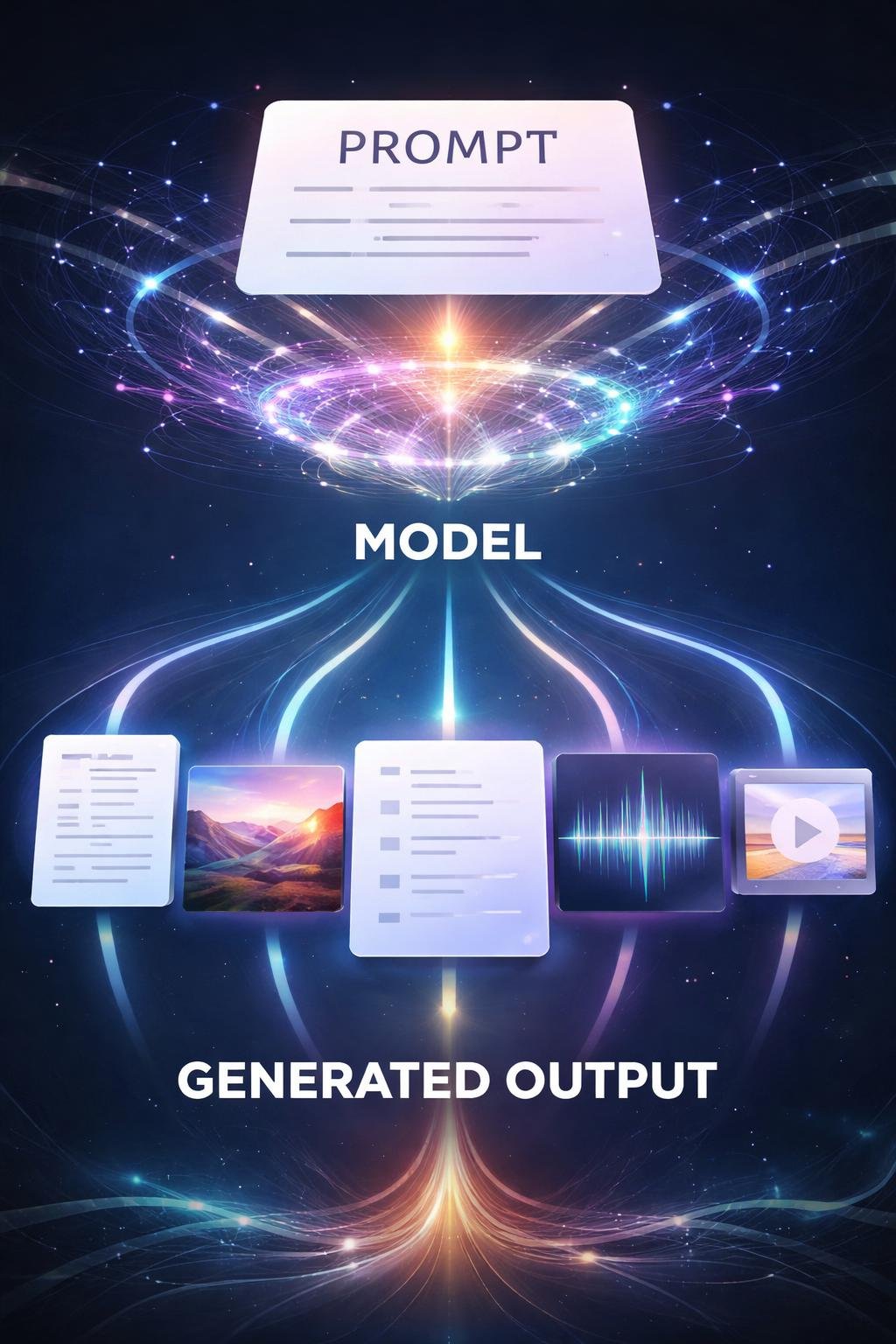
Generative AI changes how people can create and transform digital material. A user can describe a goal in everyday language and ask a suitable system to produce a draft, revise existing text, suggest code, summarize supplied information, or develop a visual concept.
This can make it easier to begin a task when the user does not know how to structure the first version. It can also support exploration by generating alternatives, changing tone or format, and explaining a topic at a requested level of detail.
However, fast generation is not the same as reliable completion. The user still needs to decide whether the result is correct, relevant, safe, lawful, and appropriate for its intended audience.
How Generative AI Creates New Content
Training
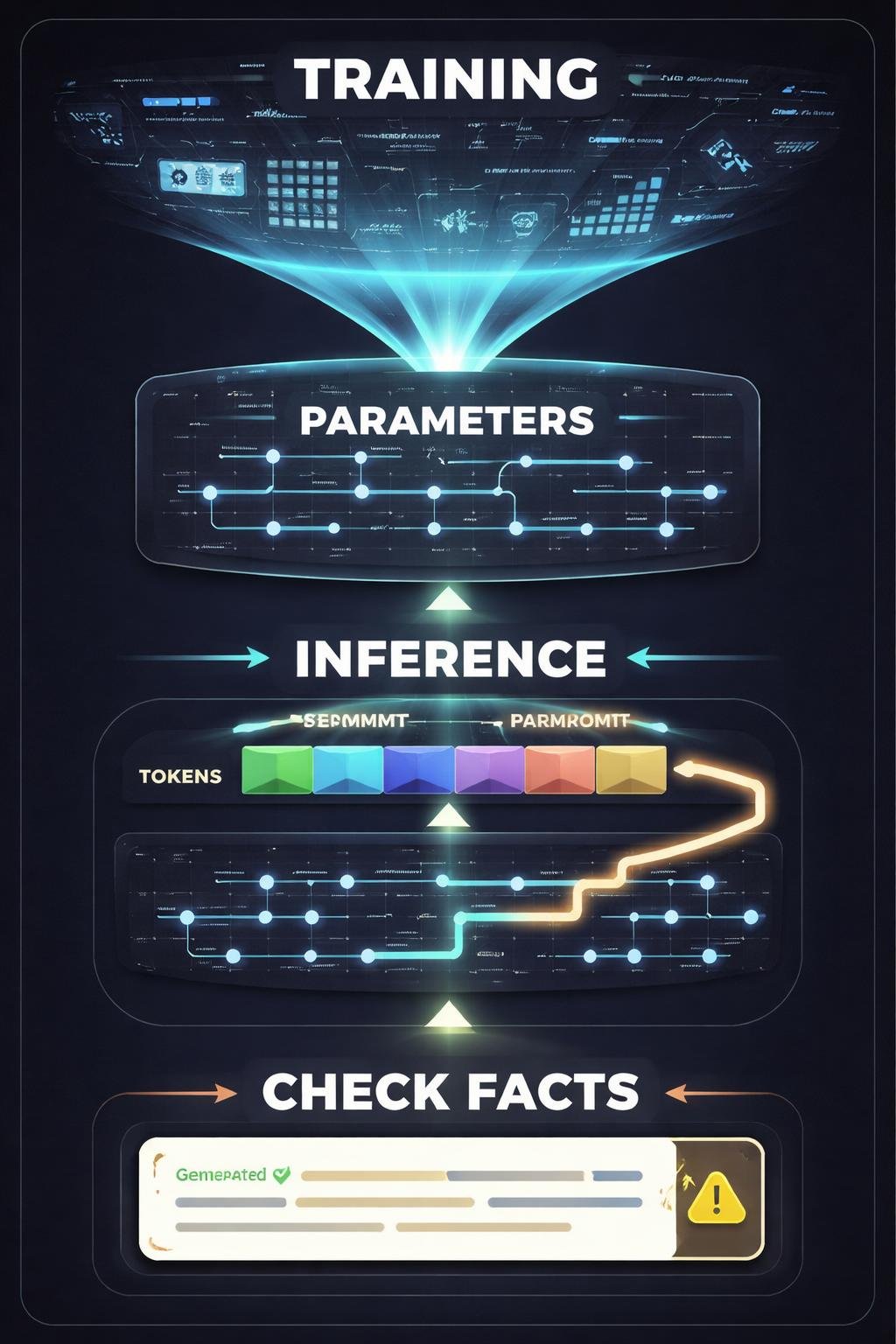
During training, a generative AI model processes many examples and learns statistical relationships within the data. Training adjusts internal numerical values, often called model parameters, so the model becomes better at representing patterns such as word relationships, visual structures, styles, or associations between different types of content.
Training does not give every model the same knowledge or capabilities. Results depend on factors that can include the model design, training process, available data, later tuning, and the surrounding system.
Inference
Inference is the stage in which a trained model responds to an input. A user supplies a prompt, which is an instruction, question, description, or other form of input. The system processes that prompt and uses the trained model to generate an output.
Training and inference are therefore different activities. Training develops the model’s learned statistical patterns, while inference applies those patterns to a particular request.
Tokens and language generation
Language models commonly break text into tokens. A token can be a whole word, part of a word, punctuation, or another text unit, depending on the model’s tokenization method.
When generating language, the model repeatedly estimates which token is likely to follow the preceding context and selects a token according to the system’s generation settings. It continues this process until it reaches a stopping condition or output limit.
Other media use different representations and generation processes, so image, audio, and video generation should not be understood as simple word prediction. The shared principle is that the model uses learned statistical patterns to construct an output corresponding to the input.
A statistically likely response is not necessarily a factually correct response. A fluent answer may contain an incorrect name, explanation, event, source, or technical detail because the generation process is optimized to produce a plausible continuation rather than to guarantee truth.
Key Components of a Generative AI System
- Training data: The examples processed while a model is trained. Their scope and characteristics influence the patterns the model can learn.
- Foundation model: A broadly trained model that can support multiple tasks and may be adapted for more specific uses.
- Prompt: The input that communicates the user’s request. A prompt may contain text, images, audio, or other supported input types.
- Tokens: Units used to process and generate language. Token boundaries do not always match complete words.
- Model parameters: Internal numerical values learned during training. They help encode relationships found in the training data.
- Generated output: The text, image, audio, video, code, or other material returned during inference.
A multimodal model can process or produce more than one type of data, such as text and images. The exact combination of supported inputs and outputs varies by model and by the product through which it is accessed.
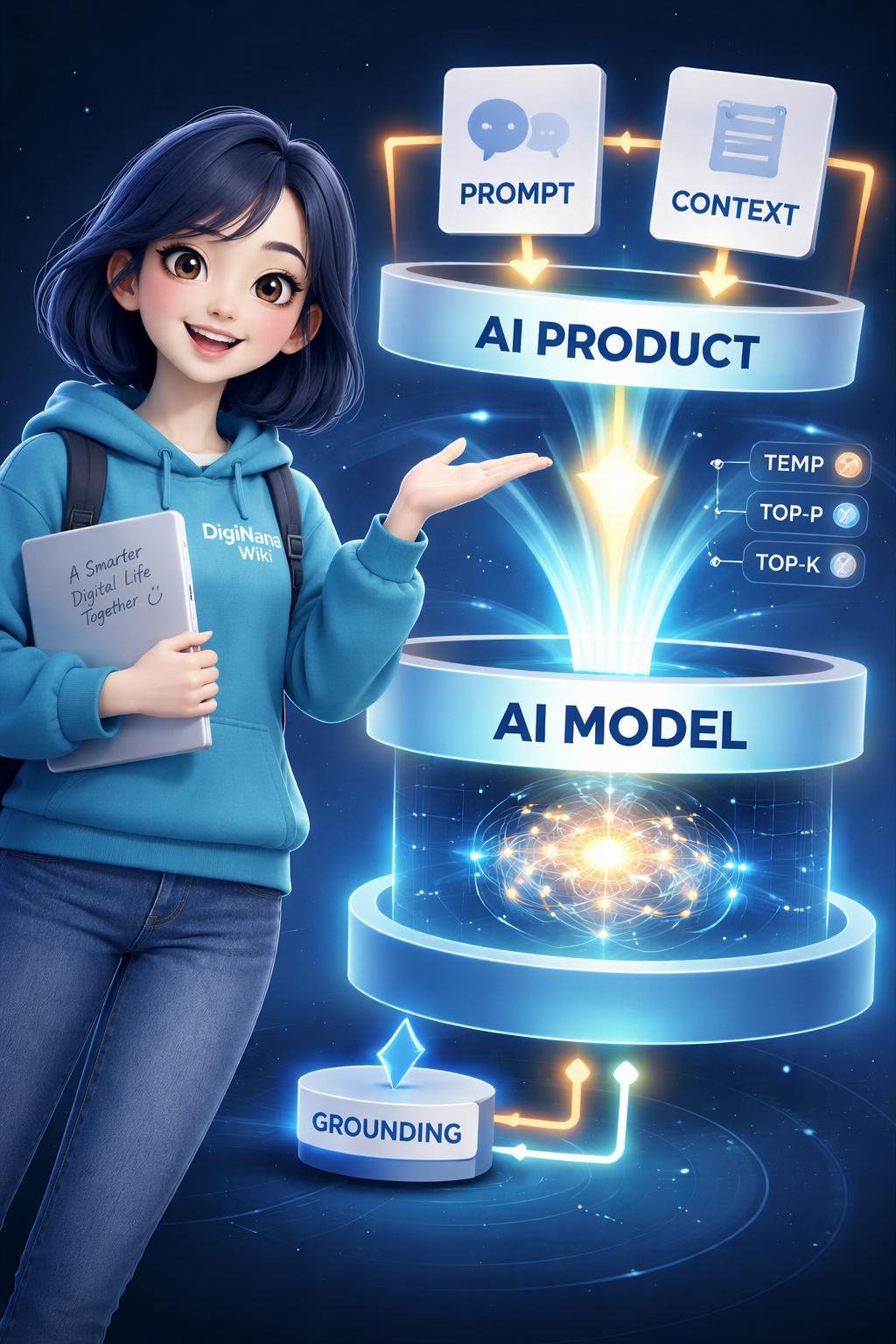
An AI model is not the same as an AI product. The model is the underlying computational system. A product may combine that model with a user interface, content filters, search tools, account controls, storage, external data, or other software.
Generation controls
Some systems expose controls such as temperature, top-P, or top-K. Temperature can affect the randomness of token selection. Top-P and top-K can restrict the set of candidate tokens considered during generation. Their exact behavior and availability depend on the system, so they should not be assumed to work identically everywhere.
Grounding, function calling, and tuning
Grounding can connect a generated answer to selected external information, such as supplied documents or a retrieval system. This may improve relevance, but users must still assess the reliability and interpretation of the underlying information.
Function calling allows a model-based system to request an external tool or software function, such as retrieving structured information or performing an action. The surrounding application decides which functions are available and how requests are validated and executed.
Task-specific tuning adapts a model for particular behavior or use cases. Grounding, function calling, tuning, and generation controls are supported concepts, but they are not universal features of every model or product.
Everyday Examples of Generative AI
Illustrative example: Drafting text. A user might ask for a polite first draft of an email explaining a schedule change. The generated message would still need to be checked for tone and factual details.
Illustrative example: Revising text. A user could supply a paragraph and request a shorter version written in simpler language. This transforms existing material rather than independently confirming its claims.
Illustrative example: Creating an image. A user might describe an imaginary garden at sunset and request a visual interpretation. The result would be generated from learned patterns, not a verified photograph of a real place.
Illustrative example: Producing code. A user could request a basic code example that sorts a list. Generated code should be reviewed, tested, and checked for security and compatibility before use.
Illustrative example: Summarizing supplied material. A user might provide an article and request a list of its main points. The summary can omit context or misrepresent a detail, so important statements should be compared with the original material.
Illustrative example: Working with audio or video. A compatible multimodal system might generate or transform supported media from a description. Available formats, controls, quality, and editing functions vary among systems.
Benefits and Limitations
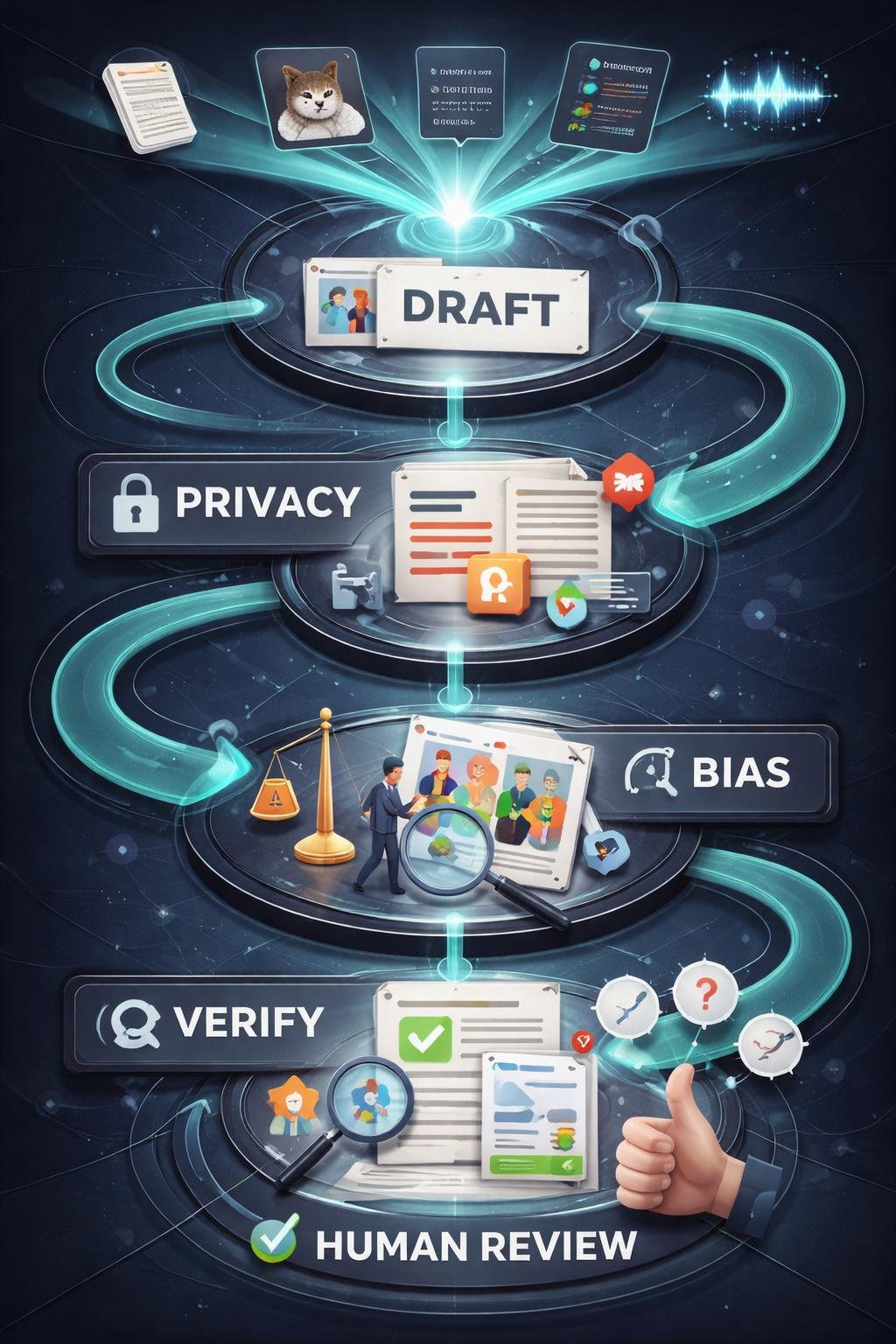
Potential benefits
Generative AI can rapidly create drafts, reformat information, suggest alternatives, and help users explore ideas. It can also adjust an explanation for a requested audience or convert supplied material into a different structure.
These benefits are most useful when the output is treated as material for review rather than as an unquestionable final answer. Human judgment remains important when the task affects other people or depends on accuracy.
Important limitations
- Hallucinations: A model can produce plausible but unsupported or false information, including invented details and references.
- Inconsistent results: Similar requests can produce different outputs, especially when generation includes randomness.
- Prompt sensitivity: Small changes in instructions or context may change the answer substantially.
- Context gaps: The model may lack essential background or misunderstand what the user intends.
- Bias: Outputs can reflect biases found in data, model development, evaluation, or the surrounding application.
- Limited suitability: An output that works as an early draft may be unsafe or inadequate for a high-stakes task.
Generated content is not guaranteed to be accurate, original, complete, current, or free from protected material. Its suitability depends on the task, the system, and the quality of human review.
Common Misunderstandings About Generative AI
It does not simply retrieve a guaranteed correct answer. A generative model constructs an output from learned statistical patterns. Some products may add search or grounding, but those additions do not guarantee that the final interpretation is correct.
It does not think or understand exactly as a person does. A model can produce language that appears knowledgeable, but fluent language alone does not demonstrate human awareness, intention, or judgment.
It does not necessarily copy one training example for every response. Generation normally combines learned patterns across many examples. Nevertheless, close resemblance or memorized material can occur, so users should review outputs for possible copyright, privacy, and originality concerns.
It does not always have current information. A model’s learned information may have limits, and access to live or recently updated sources depends on the surrounding product and its configuration.
It is not identical to an AI application. One model can be used in different products, and a product can combine several models, tools, data sources, and safety controls.
Capabilities are not universal. Input types, output formats, context limits, external tools, safeguards, and generation controls vary among models and systems.
DigiNana Beginner Guide
Hypothetical educational example: DigiNana is a fictional guide helping a beginner prepare a short announcement for a community event. She asks a generative AI system to produce a friendly draft containing the event’s supplied purpose, date, location, and contact instructions.
DigiNana reads the result instead of publishing it immediately. She compares the date and location with the original event information and notices that the draft added an activity she did not mention.
She removes the unsupported detail and revises her prompt. The new prompt tells the system to use only the information provided, keep the announcement under a chosen length, and place the confirmed details in a list.
After receiving a revised version, DigiNana checks it again, edits the tone, and takes responsibility for the final announcement. This fictional walkthrough illustrates a practical process: request a draft, review it, verify important claims, refine the prompt, and edit the final result.
Practical Tips

- State the task clearly. Explain whether you want a draft, summary, explanation, list, image concept, or code example.
- Add relevant context. Identify the intended audience, purpose, tone, and background that the model needs.
- Set useful constraints. Specify the desired length, structure, reading level, or information that must not be added.
- Request an appropriate format. Ask for paragraphs, steps, a table, or another structure that matches the task.
- Review the output critically. Look for factual errors, missing context, contradictions, unsafe suggestions, and wording that does not fit the audience.
- Verify important claims. Compare consequential names, dates, quotations, calculations, and technical statements with reliable sources.
- Refine the request. Explain what needs correction instead of assuming that the first response must be final.
- Test generated code. Review code for logic, security, dependencies, and compatibility in an appropriate test environment.
- Keep human responsibility. The person using or publishing the result remains responsible for deciding whether it is suitable.
Safety, Privacy, Bias, and Responsible Use
Do not enter confidential, personal, security-sensitive, or proprietary information into a generative AI service unless you understand the service’s current data handling, retention, access, and account policies. These practices can vary by provider, product, account type, and configuration.
Generated claims should be verified before they are used in education, business, public communication, or other consequential settings. A confident tone is not evidence that an answer is correct.
Users should also watch for biased, stereotypical, exclusionary, or misleading output. Bias can be subtle, so review should consider whose perspectives are represented, omitted, or treated unfairly.
Copyright and trademarks still matter when AI is involved. Users should avoid requesting or publishing material that improperly reproduces protected work, misuses a trademark, or creates confusion about authorship or endorsement.
When AI assistance is relevant to the audience, institution, client, or publishing policy, it should be disclosed appropriately. Users should consult the current official security, privacy, and usage documentation for the particular system they use.
Frequently Asked Questions
Is generative AI the same as a large language model?
No. A large language model, or LLM, is a type of model focused on language-related patterns and tasks. Generative AI is a broader category that also includes systems capable of generating images, audio, video, and other digital content.
What is a prompt?
A prompt is the input given to a generative AI system. It may be a question, instruction, description, example, document, image, or another supported form of input.
Is generated content always new?
Generated output is constructed during inference, but that does not guarantee complete originality. It may contain common phrases, resemble existing work, or reproduce material learned during training.
Is generative AI always accurate?
No. It can produce incorrect, unsupported, incomplete, or outdated information. Important claims should be checked against reliable sources.
What does multimodal mean?
Multimodal describes a model or system that works with more than one type of data, such as text and images. Supported combinations vary, so multimodal does not imply that every media type is accepted or generated.
Why can the same prompt produce different results?
Generation settings can allow variation when the system selects among likely output elements. Differences in system instructions, context, model versions, tools, or product configuration can also affect results.
Does generative AI have access to current information?
Not necessarily. Some systems rely mainly on information represented during training, while others may use search, grounding, databases, or external tools. Current access and reliability must be checked for the specific system.
Final Takeaway
Generative AI learns statistical patterns from training data and uses those patterns to generate text, images, audio, video, code, and other digital content in response to prompts. Training develops the model’s internal parameters, while inference uses the trained model to produce a particular output.
The underlying model should be distinguished from the product that provides the interface, external tools, data connections, and safeguards. Generative AI can be useful for drafting, transforming, and exploring content, but plausible generation does not guarantee accuracy, originality, safety, or suitability.
Clear prompts, careful editing, fact-checking, privacy awareness, and human responsibility are essential parts of using generative AI responsibly.
References
- Generative AI beginner’s guide | Gemini Enterprise Agent Platform | Google Cloud Documentation
URL: https://docs.cloud.google.com/gemini-enterprise-agent-platform/models/beginners-guide?hl=en
- generative artificial intelligence – Glossary | CSRC
URL: https://csrc.nist.gov/glossary/term/generative_artificial_intelligence
- Generative AI glossary | Google Cloud Documentation
URL: https://docs.cloud.google.com/docs/generative-ai/glossary
- What is Artificial Intelligence (AI)? | Google Cloud
URL: https://cloud.google.com/learn/what-is-artificial-intelligence
These are the verified sources used to support this article’s foundational explanations.
Image Credits
The five DigiNana Wiki visuals accompanying this article are original educational illustrations created with AI assistance. They are conceptual representations and must not be interpreted as verified photographs, exact software interfaces, actual device specifications, or guaranteed technical configurations.
Disclaimer
This article provides general educational information. Technical information, software interfaces, product features, security conditions, privacy practices, compatibility, and service availability can change. Consult current official documentation for the relevant model, product, or service whenever accuracy, privacy, security, compatibility, or availability is important.