
Introduction to Large Language Models
A large language model, usually shortened to LLM, is a type of artificial intelligence system designed to process and generate text. When a person enters a prompt, the model analyzes that text and produces a response by repeatedly predicting likely continuations.
LLMs are relevant to many text-based AI interactions. They can generate anything from a short completion to a longer passage, but their responses are probability-based outputs rather than guarantees of truth. Understanding this basic distinction helps people use them more carefully.
What Is a Large Language Model?
A large language model is a neural network trained on large collections of text. A neural network is a computational model that learns patterns by adjusting internal numerical values during training. Modern LLMs are typically based on an architecture called the Transformer.
An LLM does not process text only as complete words. A tokenizer divides text into units called tokens. Depending on the tokenizer, a token may represent a word, part of a word, or a character. Each token is converted into a numbered token ID that the model can process.
The model learns to predict tokens from surrounding or preceding tokens. By making one prediction after another, it can generate sentences, paragraphs, and longer sequences of text.
Why Large Language Models Matter
LLMs turn a text prompt into a probability-based continuation. This creates a flexible way for people to interact with AI using ordinary written language rather than a specialized command format.
Pretraining teaches a model broad patterns of text completion. Later tuning can improve its ability to follow instructions. For example, supervised fine-tuning can train a model on examples of desired responses, while reinforcement learning based on human feedback can further shape instruction-following behavior.
These capabilities make LLMs relevant to everyday text-based tasks such as drafting, explaining, summarizing, reformatting, and continuing text. The quality and accuracy of a particular response cannot be assumed, however, because generation remains a process of selecting probable tokens.
How an LLM Processes and Generates Text

Training and text generation are separate stages. Training changes the model’s internal parameters so that it learns patterns. Inference uses the trained model to process a prompt and produce an output.
Training the model
During pretraining, a model learns from large text datasets. Training methods described in the supplied sources include predicting the next token and predicting hidden or masked tokens. The difference between a prediction and the expected token is represented by a loss, and backpropagation is used to adjust the model’s parameters.
Pretraining produces a general text-completion model. Later stages can include supervised fine-tuning, instruction tuning, and reinforcement learning based on human feedback. These stages can improve instruction following, but they do not change generation into a guaranteed fact-retrieval process.
Generating a response during inference
- Tokenization: The tokenizer divides the prompt into tokens.
- Conversion to IDs: Each token is represented by a numbered token ID.
- Transformer processing: Transformer layers process the token sequence and build numerical representations of its relationships and context.
- Probability calculation: The model produces a probability distribution over possible next tokens.
- Token selection: One token is selected according to the generation method and sampling settings.
- Sequence extension: The selected token is appended to the existing sequence.
- Repetition: The expanded sequence is processed again to predict another token.
- Stopping: Generation continues until the model produces a stop token or reaches a length limit.
- Decoding: Generated token IDs are converted back into readable text.
This repeated process can create a connected response, but each step remains a prediction based on the sequence available to the model.
Key Components of a Large Language Model
| Component | Role |
|---|---|
| Tokenizer | Divides text into tokens and maps them to numbered token IDs. |
| Tokens | Represent words, subwords, or characters processed and predicted by the model. |
| Transformer layers | Build and refine numerical representations of the relationships in a token sequence. |
| Self-attention | Assigns different weights to relationships among tokens so that the model can gather relevant context. |
| Attention heads | Allow attention mechanisms to learn different token relationships in parallel. |
| Encoder | Converts input text into intermediate representations in architectures that use an encoder. |
| Decoder | Generates output tokens from representations or from previously generated tokens. |
| Context window | Defines the finite amount of tokenized material available during a generation request. |
| Sampling settings | Influence how a token is selected from the model’s probability distribution. |
Attention and representations
Self-attention weighs how strongly tokens relate to one another. Multiple attention heads can learn different relationships, while stacked Transformer layers build increasingly complex representations of the sequence.
An encoder can use bidirectional attention to consider tokens across an input sequence. A token-by-token decoder uses preceding text when generating the next token. Some Transformer systems use both encoders and decoders, while decoder-only LLMs generate new tokens from the text already in their sequence.
The context window
An LLM has a finite context window. This window may need to hold the current prompt, conversation history, added contextual material, and the generated response. It is not unlimited memory, and material outside the available context cannot simply be assumed to remain available to the model.
Sampling settings
After calculating next-token probabilities, a generation method selects a token. Sampling settings such as temperature can affect this selection process. Exact controls and their implementation can vary, so current product documentation is needed for service-specific instructions.
Everyday Examples of LLM Text Generation
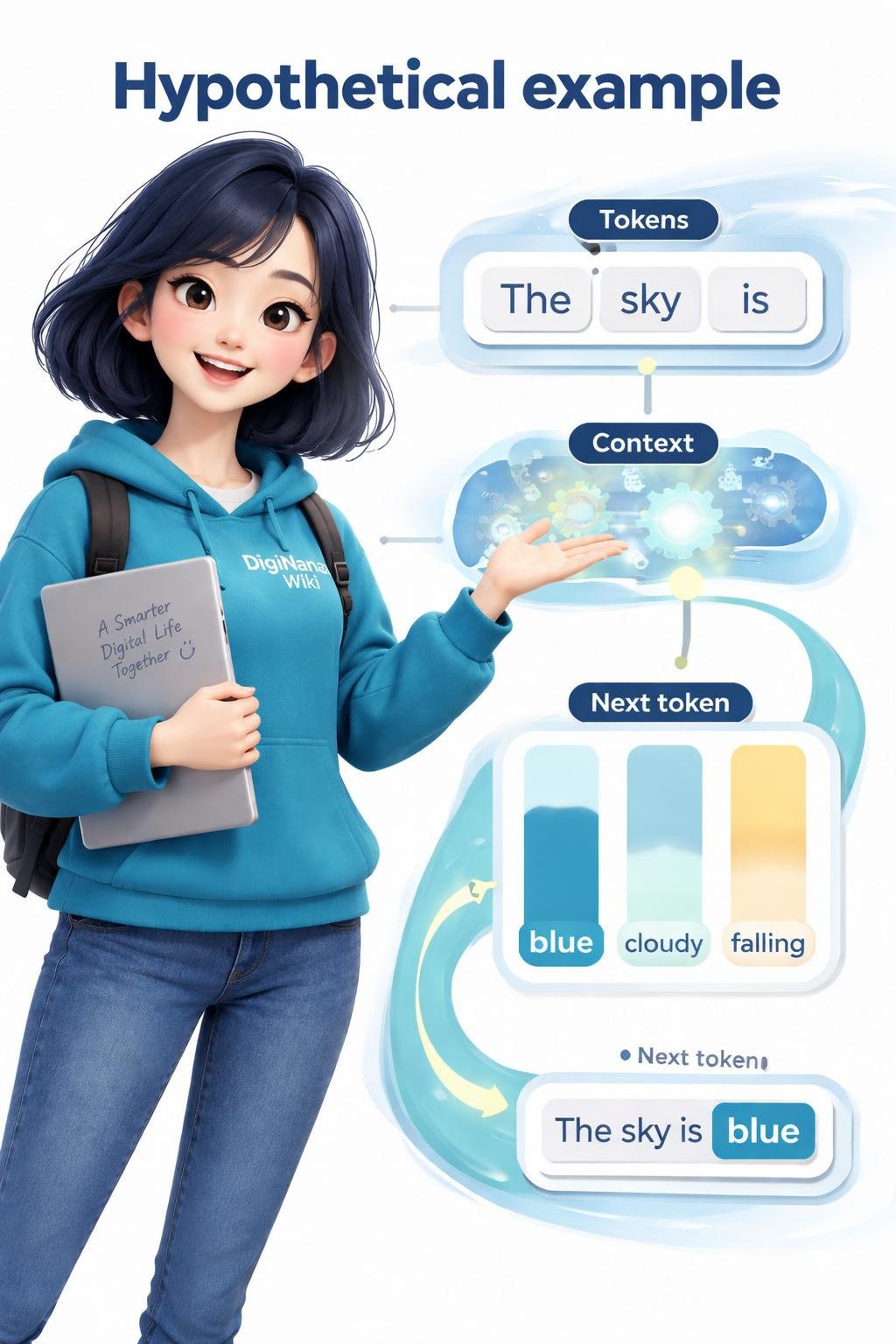
Hypothetical example 1: A user enters, “Please continue this sentence: The garden became quiet when…” A tokenizer might divide that prompt into words and subword pieces. The exact divisions depend on the tokenizer. The model then calculates possible next tokens, selects one, appends it, and repeats the process to form a sentence.
Hypothetical example 2: A user requests a short paragraph explaining why plants need light. The prompt and its instructions enter the context window as tokens. The model generates the answer one token at a time until it produces a stop token or reaches a limit.
Hypothetical example 3: A user asks for a longer response with headings. If the instruction remains available in the context, the model can generate token sequences that form headings and paragraphs. This example illustrates the generation process; it is not a test of any particular model or product.
Benefits and Limitations of LLMs
Benefits
- LLMs can generate sequences ranging from a short token completion to multiple paragraphs.
- Self-attention helps a model use relationships among tokens when processing context.
- Instruction tuning and other supported tuning methods can improve instruction following.
- The same token-prediction process can support different text formats when suitable instructions are provided.
Limitations and trade-offs
- The context window is finite and must be shared among prompts, history, added context, and generated output.
- Generation may stop because of a stop token or a length limit.
- Token selection is probabilistic, so outputs can vary.
- A probable continuation is not necessarily a correct statement.
- Fluent wording can make unsupported or fabricated information appear convincing. Such output is commonly described as an AI hallucination and should be checked rather than trusted automatically.
Tuning can improve how a model follows instructions, but it does not remove uncertainty from token prediction. Benefits therefore need to be balanced with review and verification.
Common Misunderstandings About LLMs
“Every token is a complete word”
A token can be a word, a subword, or a character. Token boundaries do not necessarily match the word boundaries visible to a reader.
“Training happens whenever the model answers”
Training adjusts the model’s parameters. Inference uses an already trained model to generate a response. These are different processes.
“An LLM and an AI product are the same thing”
An LLM is a model. A product can place an interface and other systems around a model. Features, data handling, retrieval tools, and service conditions belong to the particular product and cannot be inferred from the general definition of an LLM.
“The most probable text must be true”
Probability-based generation predicts a plausible continuation. It does not independently guarantee that every generated claim is accurate.
“The context window is unlimited memory”
A context window has a finite capacity. It contains the tokenized material available for the current processing sequence, not an unlimited record of all previous information.
DigiNana Beginner Guide
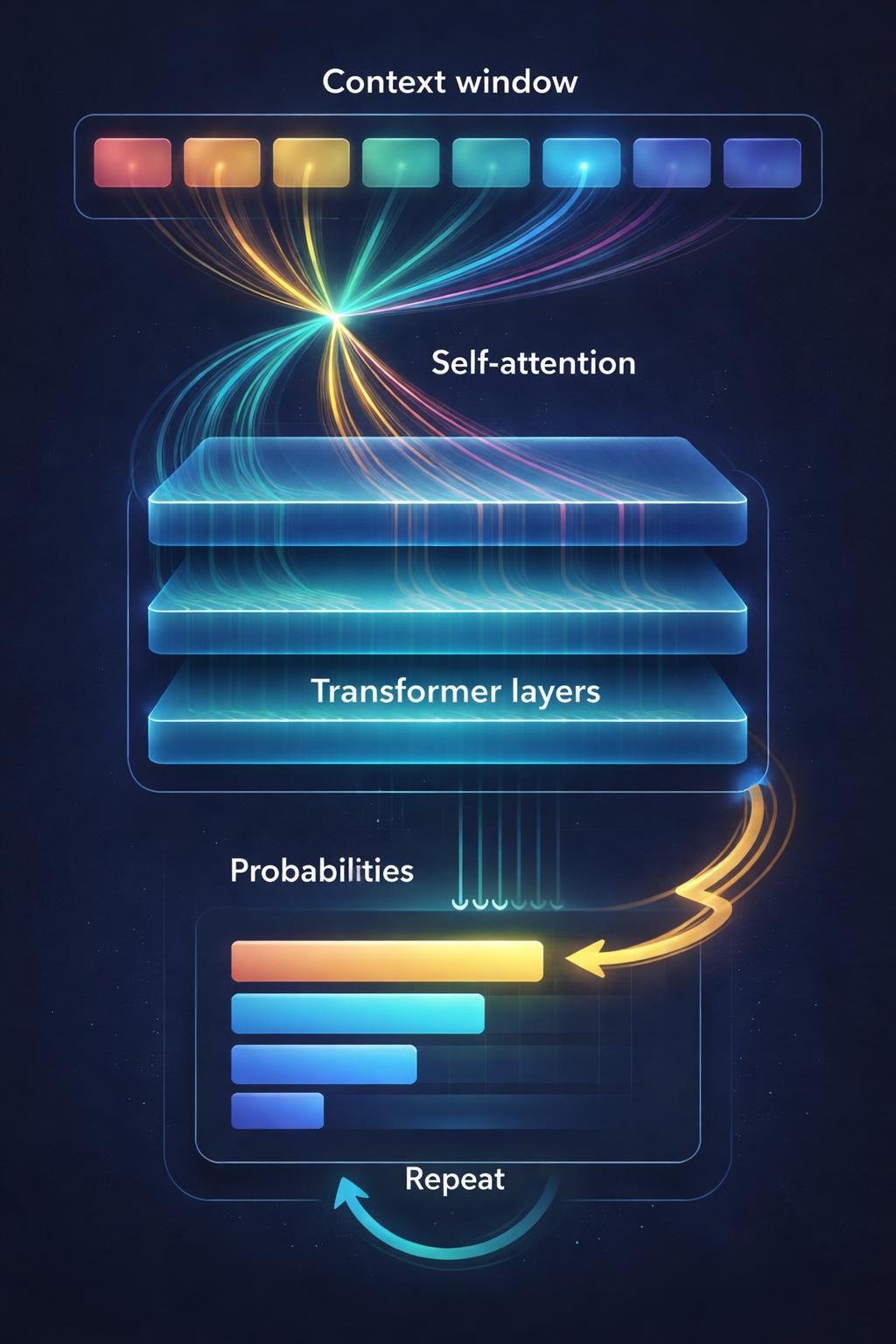
Fictional educational example: DigiNana enters the prompt, “Finish this sentence in a friendly tone: A rainy afternoon is a good time to…” The following walkthrough illustrates the process and is not a record of a real model test.
- The tokenizer divides DigiNana’s prompt into hypothetical word and subword tokens and converts them into numbered IDs.
- Transformer layers process those IDs. Self-attention weighs relationships among tokens, including the instruction about a friendly tone and the unfinished sentence.
- The model calculates a probability distribution for possible next tokens. In this fictional illustration, possibilities might correspond to continuations such as “read,” “rest,” or “make.” These are examples, not measured probabilities.
- The generation method selects one token and adds it to the sequence.
- The model processes the longer sequence and calculates probabilities for the following token.
- This selection cycle repeats until a stop token or length limit ends generation.
- The tokenizer’s decoding process converts the generated token IDs into readable text for DigiNana.
The technical principle behind the story is that the response is assembled through repeated token prediction. The example does not establish how any specific service would divide the prompt, rank the tokens, or word the final answer.
Practical Tips
- State the task clearly: Explain the desired subject, format, audience, and level of detail.
- Supply relevant context: Include information the model needs rather than assuming it has access to material outside the prompt or available context.
- Remember the context limit: Long prompts, conversation history, supporting material, and the response all compete for finite context space.
- Review the output: Check whether the response followed the request and whether its statements are supported.
- Verify important claims: Compare consequential facts with current authoritative sources instead of treating fluent text as proof.
- Separate drafting from validation: An LLM can help produce wording, but the generated wording still requires human review.
- Use current documentation: Consult official instructions for product-specific controls, limits, privacy terms, and features.
Safety, Privacy, Bias, and Responsible Use

Because an LLM generates probable continuations, a coherent response is not a guarantee of accuracy. Incorrect or unsupported text can contribute to misinformation when it is repeated without checking. Important names, quotations, instructions, and factual claims should therefore be verified against suitable authoritative material.
Privacy and data-handling practices depend on the service surrounding a model. The supplied technical sources do not establish how individual services store, use, transmit, or retain prompts. Before entering personal, confidential, or sensitive information, users should consult the current official privacy and security documentation for the service involved.
Generated text should also be reviewed for unfair assumptions, missing perspectives, or biased framing rather than presumed to be neutral. Service-specific bias assessments and mitigation claims require separate supporting evidence.
Responsible use includes identifying AI-generated drafts where appropriate, applying human judgment, checking important claims, and avoiding reliance on an unverified response for consequential decisions.
Frequently Asked Questions
What does LLM mean?
LLM means large language model. It is a neural network, typically based on Transformer architecture, that learns text patterns and generates sequences by predicting tokens.
What is a token?
A token is a text unit processed by a language model. It can represent a word, part of a word, or a character.
How is training different from inference?
Training adjusts a model’s parameters as it learns patterns from data. Inference uses the trained parameters to process a prompt and generate an output.
How does self-attention provide context?
Self-attention weighs relationships among tokens in a sequence. This allows the model to build representations that reflect which tokens are relevant to one another.
What does a context window contain?
A context window can contain the prompt, conversation history, added contextual material, and generated response. Its capacity is finite.
Why can LLM outputs vary?
The model assigns probabilities to possible next tokens, and a generation method selects among them. Sampling settings can influence this process, so the same prompt does not necessarily imply identical wording every time.
Is an LLM response guaranteed to be accurate?
No. An LLM generates probable text continuations, so its output must not be treated as guaranteed fact. Important information should be checked against authoritative sources.
Final Takeaway

A large language model is a neural network, usually based on Transformer architecture, that processes tokens and repeatedly predicts probable continuations. A tokenizer converts text into token IDs, Transformer layers and attention mechanisms process contextual relationships, and a decoder turns generated IDs back into readable text.
Pretraining teaches broad text patterns, while later tuning can improve instruction following. Inference is the separate stage in which the trained model answers a prompt. Context limits, sampling choices, length limits, and probabilistic generation affect the resulting response, so generated text always requires an appropriate level of review and verification.
References
- LLM Fundamentals | Microsoft Learn — https://learn.microsoft.com/agent-framework/journey/llm-fundamentals
- LLMs: What’s a large language model? | Machine Learning | Google for Developers — https://developers.google.com/machine-learning/crash-course/llm/transformers?authuser=50&hl=en
- LLMs: What’s a large language model? | Machine Learning | Google for Developers — https://developers.google.com/machine-learning/crash-course/llm/transformers
Image Credits
The five DigiNana Wiki visuals accompanying this article are original educational illustrations created with AI assistance. They are conceptual visual aids and must not be interpreted as verified photographs, exact software interfaces, actual device specifications, or guaranteed technical configurations.
Disclaimer
This article provides general educational information. Technical information, software interfaces, product features, security conditions, and service availability can change. Consult current official documentation whenever accurate, security-sensitive, or operationally important details are required.