
Introduction
Machine learning is a way of building software that learns patterns from data. Instead of receiving a separate fixed instruction for every possible situation, the software is trained on examples and produces a model that can make predictions, classify information, identify groups, select actions, or generate content.
Machine learning supports many kinds of modern digital systems, but it is important to separate two stages. During training, a system learns relationships from data. During inference, the trained model applies those learned relationships to new input. A useful result still depends on suitable data, careful evaluation, and responsible use.
What Is Machine Learning?
Machine learning is a method of training software called a model to learn mathematical relationships and patterns from data. Once trained, the model can use those relationships to make predictions or generate new content based on an input.
Data is the information used for training, evaluation, or inference. A dataset may contain numbers, text, images, audio, or other digital representations.
Features are the input characteristics provided to a model. In a simple housing-price example, features might include floor area and number of rooms. A label is a known answer associated with an example, such as the recorded sale price or the correct category.
A prediction is the model’s output for an input. It may be a numeric value, a category, a suggested action, or generated content. The model is the learned mathematical system that produces this output; it is not necessarily the entire application or service that a person uses.
Why Machine Learning Matters

Machine learning is useful when writing complete fixed rules would be difficult or when useful relationships can be learned from examples. It can apply patterns found during training to new inputs, although the resulting outputs are not guaranteed to be correct.
Different machine-learning tasks serve different purposes. Prediction can estimate a numeric value. Classification can assign an input to a category. Grouping can organize similar items without requiring known category labels. Other approaches can learn action-selection strategies or generate new content that reflects patterns in training data.
These abilities are relevant to everyday digital life because many digital tasks involve sorting information, estimating outcomes, recognizing similarities, or responding to new input. However, the presence of machine learning does not by itself establish that a system is accurate, fair, secure, or appropriate for every situation.
How Machine Learning Works

- Define the task. The developer identifies the intended input and output. The task might be predicting a number, assigning a category, finding groups, choosing actions, or generating content.
- Collect and prepare data. Relevant examples are gathered and converted into a usable form. Preparation can include checking labels, selecting features, correcting format problems, and separating data for training and evaluation.
- Train the model. A learning algorithm adjusts the model so that its outputs better reflect patterns in the training examples. The exact process depends on the type of machine learning being used.
- Evaluate the result. The model is tested on data that was not used to fit it. When labeled evaluation data is available, its predictions can be compared with the known labels using measures chosen for the task.
- Revise and retrain. Poor results may lead developers to improve features, use more relevant or diverse examples, correct data problems, adjust the training process, and train again. Useful models can require multiple training rounds.
- Use the model for inference. After training, the model receives new input and produces an output. This use of an already trained model is called inference.
Training and inference are related but different. Training creates or adjusts the learned model, while inference uses the resulting model. A deployed product does not necessarily continue training whenever a person uses it; whether later learning occurs depends on the system’s design and processes.
Key Components and Types of Machine Learning
Core components
| Component | Role |
|---|---|
| Dataset | A collection of examples used for training, evaluation, or other analysis. |
| Feature | An input characteristic supplied to the model. |
| Label | A known target or correct answer attached to a labeled example. |
| Algorithm | A procedure used to learn from data or adjust a model. |
| Model | The learned mathematical representation used to produce outputs. |
| Prediction | An output produced for a particular input. |
| Evaluation | The process of examining how well outputs meet criteria selected for the task. |
| Policy | In reinforcement learning, a strategy for selecting actions in an environment. |
Supervised learning
Supervised learning uses labeled examples. The model receives features and corresponding correct answers, then learns to predict a label from new features.
Regression predicts numeric values. Classification predicts discrete categories. The quality of either type must be evaluated in relation to its intended task and the consequences of errors.
Unsupervised learning
Unsupervised learning works with examples that do not have target labels. It looks for structure in the data. Clustering is one such task and groups data points according to patterns of similarity found by the method.
Reinforcement learning
Reinforcement learning involves an agent selecting actions in an environment. Rewards and penalties provide feedback, and the learning process develops a policy intended to guide later action selection. A reward design may not represent every real-world goal or consequence, so evaluation remains necessary.
Generative AI
Generative artificial intelligence learns patterns from existing data and uses them to create new, similar content. Depending on the system, a generative model may also be refined through supervised or reinforcement-learning methods. Generated output is based on learned patterns and should not automatically be treated as verified fact.
Everyday Examples of Machine Learning
The following examples are illustrative. They explain task types and are not claims about a particular product or real-world test.
- Regression example: A model receives features describing electricity use and predicts a numeric value for future consumption.
- Classification example: A model examines features from a message and predicts one of several predefined categories, such as personal, work, or promotional.
- Clustering example: An application groups a collection of documents according to similarities in their digital representations, without being given a correct category for each document.
- Reinforcement-learning example: A simulated agent tries different actions in a virtual environment and receives rewards or penalties, gradually developing a policy for selecting actions.
- Generative AI example: A model receives a text instruction and creates a new passage based on patterns learned during training. The passage may sound convincing even when some details are inaccurate.
These examples describe general possibilities. Actual behavior depends on the data, model, evaluation process, surrounding software, and conditions in which the system is used.
Benefits and Limitations
Potential benefits
- Machine learning can find relationships in data that are difficult to express as a complete set of fixed rules.
- A trained model can apply learned relationships to new inputs.
- Different methods can support numeric prediction, categorization, grouping, action selection, and content generation.
- Evaluation can help developers identify weaknesses and compare model outputs with appropriate targets or criteria.
Important limitations
- Predictions can be wrong, uncertain, or unsuitable for the context.
- Results depend on whether the training data and features are relevant to the intended task.
- Limited, unrepresentative, incorrectly labeled, or biased data can contribute to weak or unfair results.
- Models may need repeated training and evaluation rather than succeeding after one training run.
- Patterns that worked in training data may not transfer reliably to different people, environments, or changing conditions.
- Generative models can produce inaccurate or unsupported content, sometimes called a hallucination.
A theoretical ability to perform a task is not the same as dependable real-world behavior. Reliability must be assessed under conditions that reflect the intended use, and even a useful model may fail on unfamiliar inputs.
Common Misunderstandings About Machine Learning
“Machine learning is just fixed rule-based programming.”
Conventional programs can follow rules written directly by developers. Machine-learning models instead learn mathematical relationships from examples. In practice, a product may combine learned models with fixed rules and conventional software.
“A model is the same as an AI product.”
A model is one component. A complete product may also include a user interface, data-processing systems, databases, security controls, fixed business rules, and human review.
“Training and inference are the same.”
Training adjusts a model using data. Inference applies a trained model to new input. They are separate stages even when the same service supports both.
“All machine learning needs labeled examples.”
Supervised learning uses labeled examples, but unsupervised learning can find structures such as clusters in unlabeled data. Reinforcement learning uses feedback from rewards and penalties rather than ordinary category labels.
“Model outputs are always correct.”
A model produces an estimate, category, action, or generated result based on learned patterns. Its output can be incorrect or misleading and must be interpreted according to the task, evaluation evidence, and consequences of error.
DigiNana Beginner Guide

Hypothetical educational example: DigiNana wants to explain a simple model that predicts how many minutes a fictional learner might need to complete a practice exercise. This is an illustration only, not a real test, service, or claim about learner performance.
- Data: DigiNana creates a fictional dataset of past practice sessions.
- Features: The inputs include the number of questions and a broad difficulty setting.
- Labels: Each training example has a known completion time. This numeric label makes the example a supervised regression task.
- Training: A learning algorithm uses the examples to adjust a model so it can estimate completion time from the selected features.
- Evaluation: DigiNana tests the model on separate labeled examples and compares its predictions with the known completion times. Large or frequent errors would indicate that the model needs investigation.
- Inference: After training, a new number of questions and difficulty setting are supplied to the model. It returns an estimated time.
The prediction is not a promise. Relevant information may be missing, individual circumstances can differ, and the fictional model may perform poorly on examples unlike its training data. The example shows the workflow from data to inference without representing an actual product.
Practical Tips
- Identify the task. Ask whether the system predicts a number, selects a category, finds groups, recommends an action, or generates content.
- Find the input and output. Knowing what enters the system and what comes out makes its purpose easier to understand.
- Separate the model from the product. A visible application may use a model alongside databases, rules, interfaces, and human processes.
- Ask how performance is evaluated. Look for criteria relevant to the intended task rather than assuming that one general score proves reliability.
- Consider the operating context. A model evaluated on one type of data may behave differently with unfamiliar inputs.
- Treat outputs as fallible. Check important predictions and generated factual statements rather than accepting them automatically.
- Check current documentation. For details about a particular product, including its data handling and available controls, consult the provider’s current official documentation.
These checks do not guarantee a good outcome, but they help beginners ask clearer questions about what a machine-learning system does and how its output should be used.
Safety, Privacy, Bias, and Responsible Use
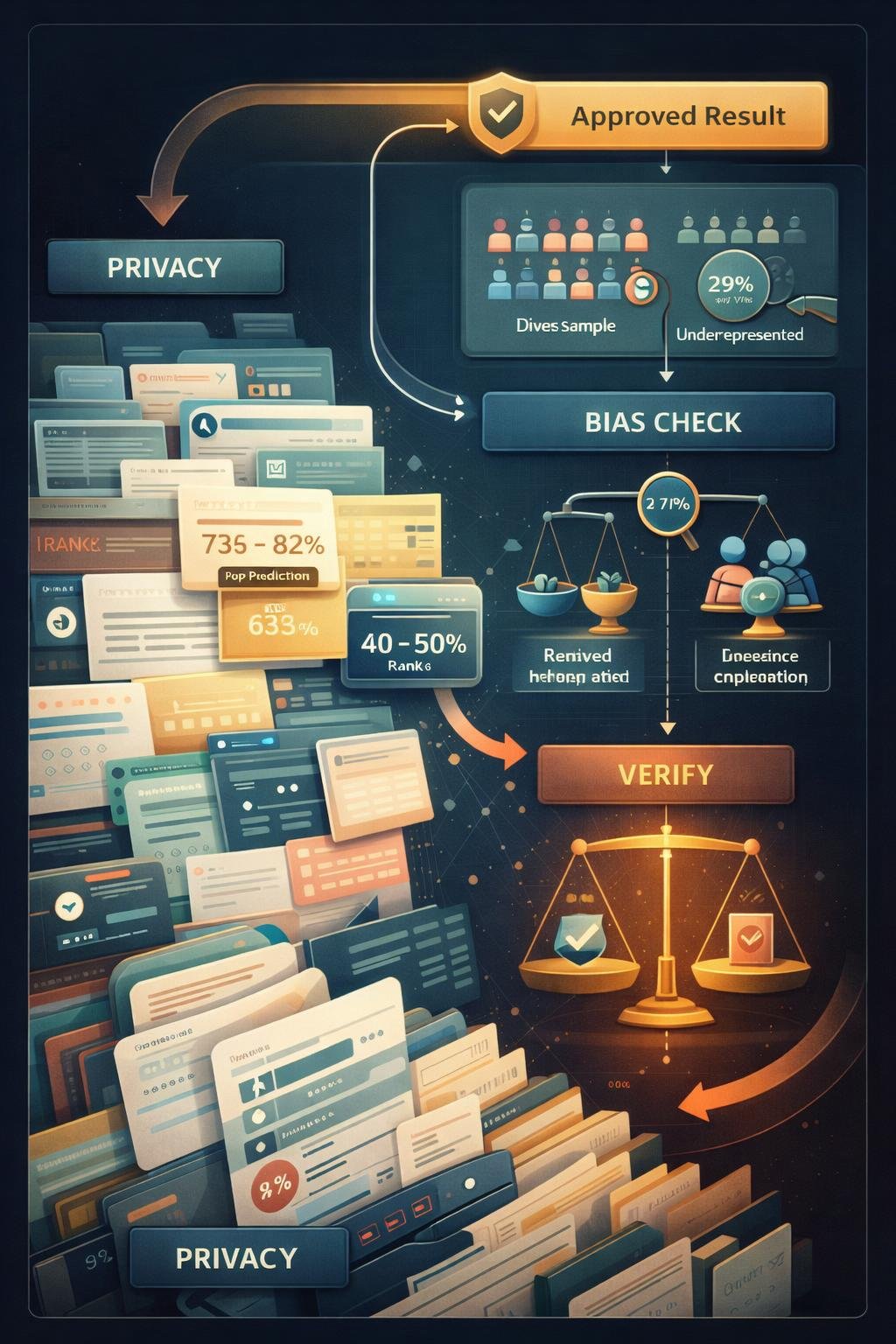
Avoid entering confidential, personal, or otherwise sensitive information into a machine-learning service unless its current data-handling terms, access controls, and intended use are understood and appropriate. A convenient interface does not by itself establish how information is stored, reused, or protected.
Datasets can reflect missing perspectives, historical inequalities, collection errors, or unbalanced representation. Models can learn patterns associated with those problems, and outputs may affect groups differently. Bias should therefore be investigated through relevant data review, evaluation, monitoring, and human oversight.
Consequential outputs should receive appropriate human review. The required level of checking depends on the decision and the harm that an error could cause. Generated text can contain fabricated or inaccurate details, while predictive systems can misclassify people or situations.
Responsible use includes limiting unnecessary data collection, checking factual claims against reliable evidence, documenting uncertainty, providing ways to question important outputs, and avoiding uses for which the system has not been adequately evaluated. No general description of machine learning can provide a security or accuracy guarantee for a specific service.
Frequently Asked Questions
What is machine learning in simple terms?
Machine learning is a method that trains a software model to learn patterns from data and use those patterns to produce outputs for new inputs.
How is machine learning different from conventional programming?
Conventional programming commonly uses rules written directly by people. Machine learning derives mathematical relationships from examples. Many practical systems combine both approaches.
What is the difference between supervised and unsupervised learning?
Supervised learning uses examples with known labels and learns to predict those labels. Unsupervised learning uses unlabeled examples to discover structure, such as groups of similar data points.
What do regression and classification mean?
Regression predicts a numeric value. Classification predicts a discrete category. Both are supervised-learning tasks when they are trained with labeled examples.
Does a model keep learning whenever someone uses it?
Not necessarily. Ordinary inference uses an already trained model without automatically changing it. Some systems may collect feedback or undergo later retraining, but that depends on their design and should be confirmed through current documentation.
How is a machine-learning model evaluated?
Evaluation tests the model using data and criteria appropriate to the task. When labeled evaluation examples are available, predictions can be compared with their known labels. Evaluation should also consider the intended context and the consequences of different errors.
Can machine-learning predictions be wrong?
Yes. Outputs can be wrong because of limited data, unsuitable features, changing conditions, unfamiliar inputs, model limitations, or other problems. Important results need verification and appropriate human judgment.
Final Takeaway

Machine learning trains models to learn mathematical patterns from data. Supervised learning uses labeled examples for tasks such as regression and classification, unsupervised learning can discover clusters in unlabeled data, reinforcement learning develops action-selection policies through rewards and penalties, and generative AI creates new content based on learned patterns.
Training must be distinguished from inference: training builds or adjusts a model, while inference uses the trained model on new input. Even when a model is useful, its outputs require suitable evaluation, context, privacy awareness, bias checks, and responsible human judgment.
References
The following supplied sources support the article’s definitions of machine learning, supervised learning, regression, classification, unsupervised learning, clustering, reinforcement learning, generative AI, model evaluation, and iterative retraining.
- What is Machine Learning? | Google for Developers — https://developers.google.com/machine-learning/intro-to-ml/what-is-ml
- Test Your Understanding | Machine Learning | Google for Developers — https://developers.google.com/machine-learning/intro-to-ml/understanding
Image Credits
The five DigiNana Wiki visuals accompanying this article are original educational illustrations created with AI assistance. They are conceptual visuals and must not be interpreted as verified photographs, exact software interfaces, actual device specifications, or guaranteed technical configurations.
Disclaimer
This article provides general educational information. Technical information, software interfaces, product features, security conditions, and service availability can change. Verify important, operational, or current details using the relevant provider’s official documentation before relying on them.