
Introduction to AI Hallucinations
The question “what are AI hallucinations” matters because a generative artificial intelligence system can produce an answer that sounds convincing even when it is inaccurate or invented. Fluent wording, detailed explanations, and confident language do not prove that an output is true.
This problem affects everyday uses of generative AI, including research, writing, learning, and information searches. Users therefore need to treat generated content as material to review rather than as automatically verified knowledge.
What Is an AI Hallucination?

An AI hallucination is plausible-sounding output that is factually wrong, irrelevant, or fabricated. The term describes a failure in generated content; it does not mean that a machine experiences perception in the way a person does.
A hallucination can take several forms. A system might invent a study, provide a fake citation, name a web page that does not exist, state an incorrect detail, or produce information that does not answer the question. Because these outputs can resemble reliable information, the error may not be immediately obvious.
Why AI Hallucinations Matter
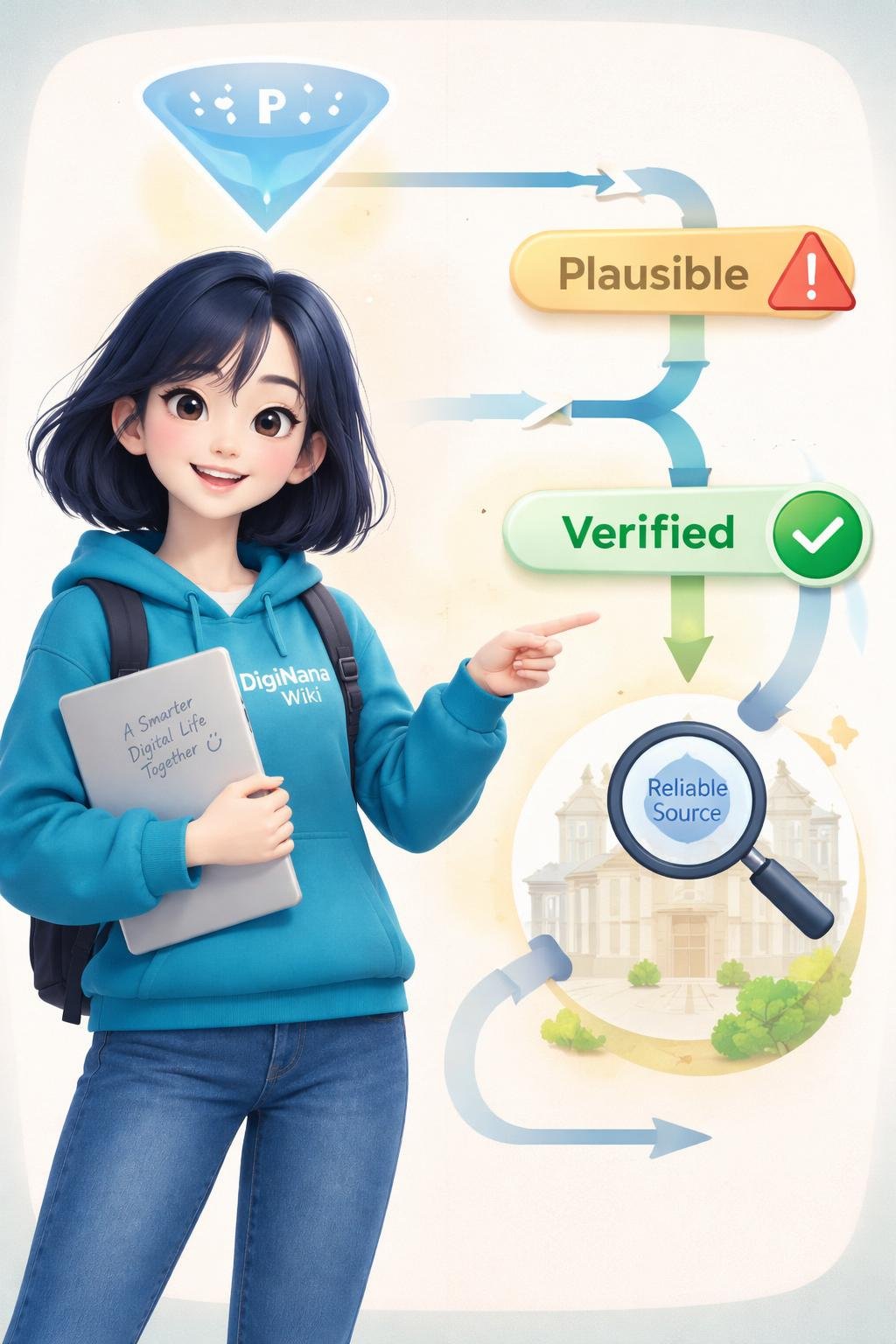
Inaccurate output can mislead someone who uses generative AI to investigate a topic, prepare a document, learn a subject, or complete another digital task. A fabricated citation could waste the reader’s time, while an incorrect factual detail could be repeated in published material.
Confident presentation increases the practical risk. Readers may assume that a well-structured response has been checked, even though generative models predict plausible output rather than guarantee factual correctness. Important claims should therefore be verified independently.
Why Generative AI Hallucinations Happen
Generative models learn statistical patterns from training data. During training, a model adjusts its internal patterns using available data. The quality and coverage of that data matter: inaccurate, biased, incomplete, sparse, or ambiguous information can contribute to unreliable output.
Inference is the later stage in which a trained model responds to a prompt. At this stage, a generative language model predicts statistically likely word sequences from learned patterns. It does not automatically retrieve a verified fact or know that a statement is true.
This likelihood-focused design allows a model to generate fluent text, but it can also encourage gap-filling. If the available patterns do not provide a clear answer, the model may produce a plausible detail that is unsupported or false.
Prompts also influence the result. Vague, ambiguous, or unfamiliar requests can leave too much room for an unreliable interpretation. A model may additionally rely on spurious correlations, meaning patterns that appear connected in the data without providing a sound basis for the answer. Adversarial inputs deliberately designed to manipulate a system can create further problems.
Key Factors That Shape AI Answers
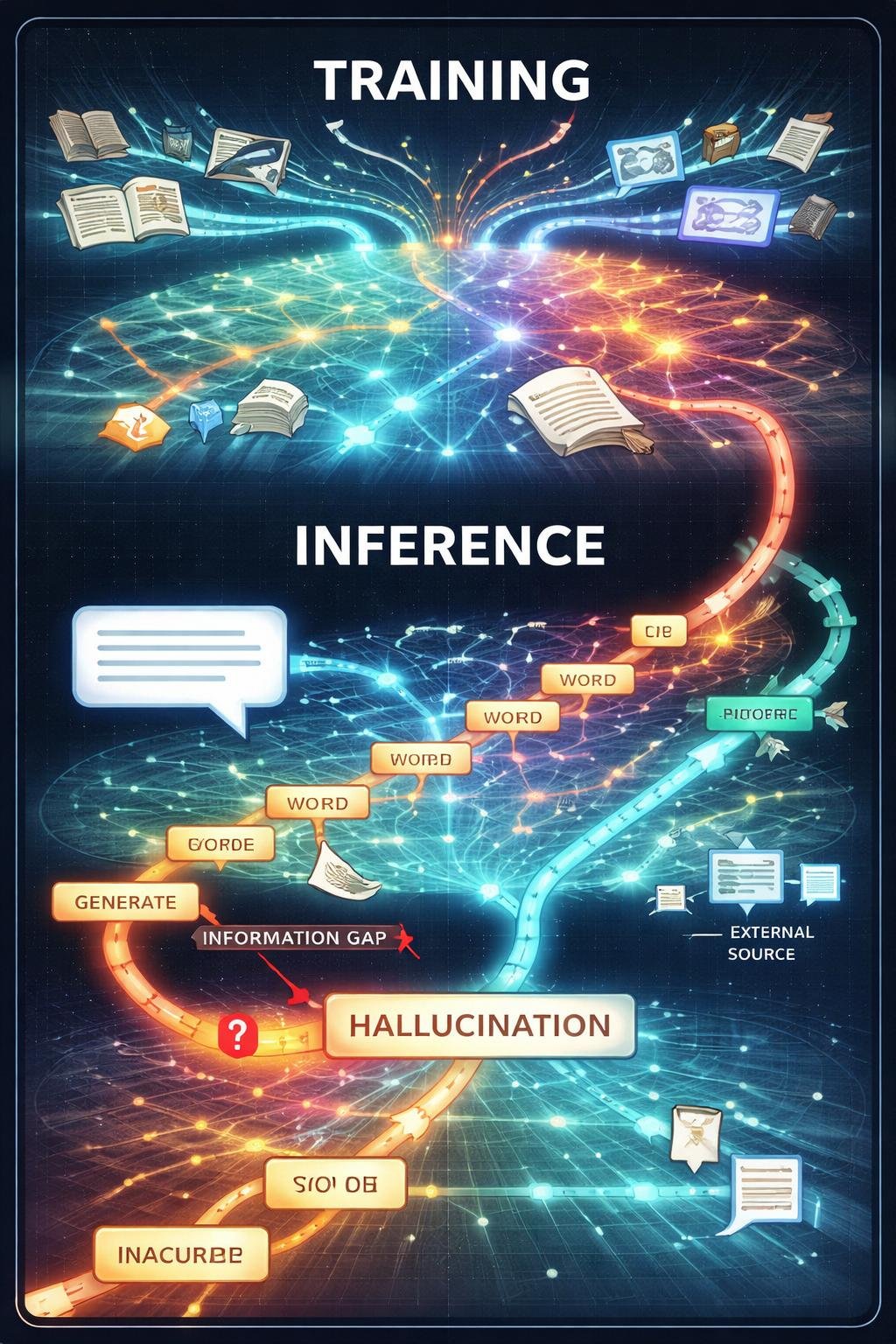
- Training data: The information used during training shapes the patterns the model can learn. Missing, inaccurate, or biased material can affect later output.
- The model: The underlying model generates output according to learned patterns and its design. Plausibility is not the same as verified truth.
- The prompt: The user’s instructions provide context for the response. Clearer structure can reduce ambiguity, although it cannot guarantee accuracy.
- Generated output: The answer is a new response produced during inference. It must be evaluated separately from the prompt and training process.
- External information: Some systems may be configured to retrieve relevant material and provide it to the model. This can improve grounding, but the resulting claims still require review.
An AI model is not the same as an AI product. The model is the underlying system that generates output, while a product or interface is the service through which a person interacts with that model. The interface, available tools, external information sources, and review controls can differ, so users should not assume that every product using a model behaves identically.
Everyday Examples of AI Hallucinations
The following are hypothetical educational illustrations, not reports of real product tests.
- Hypothetical fabricated citation: A learner asks for academic sources, and the system supplies a convincing article title and author combination that cannot be found in the claimed publication.
- Hypothetical nonexistent web page: A response provides a realistic-looking web address, but the page does not exist.
- Hypothetical incorrect detail: A user requests a summary, and the answer includes a specific factual detail that is not supported by the original material.
- Hypothetical irrelevant response: A person asks about one technical concept, but the system gives a polished explanation of a different concept.
- Hypothetical gap-filling: A prompt leaves an important detail unclear, and the system invents that detail instead of identifying the uncertainty.
These examples show why appearance alone is not a reliable test of accuracy.
Capabilities, Limitations, and Trade-Offs
Generative AI can produce fluent language that helps people draft, reorganize, explain, or summarize information. The same ability to generate plausible text also creates a central limitation: plausible wording may be produced without a reliable factual basis.
This creates a trade-off between flexible generation and factual reliability. A response can be readable and useful while still containing an invented citation, an incorrect detail, or an unsupported conclusion. Fluency and accuracy must therefore be evaluated separately.
Methods such as higher-quality data, domain-specific fine-tuning, retrieval-augmented generation, structured prompts, human review, monitoring, and governance can reduce hallucinations. They cannot fully eliminate the possibility of inaccurate output, so no mitigation should be treated as a guarantee.
Common Misunderstandings About AI Hallucinations
- “Confident wording proves accuracy.” Confidence in the writing style does not show that a claim has been verified.
- “A generative model is a fact database.” A generative model predicts likely output from learned patterns rather than automatically retrieving verified facts.
- “Every false answer is intentional deception.” A hallucination can result from how generative output is produced. The label does not establish an intention to deceive.
- “One safeguard guarantees correctness.” Clear prompts, retrieval, fine-tuning, and review can reduce risk, but none makes every response correct.
- “Hallucination means human-like perception.” In this context, hallucination is a technical label for unreliable generated output. It does not imply that the system has human senses or experiences.
DigiNana Beginner Guide
Hypothetical educational example: DigiNana, a fictional guide, asks a generative AI system for a short explanation of a topic and receives an answer containing a detailed citation.
Instead of assuming that the citation is genuine, DigiNana separates it into checkable parts: the title, author, publisher, and claimed web address. She looks for the cited material through an appropriate authoritative source and checks whether the source actually supports the statement in the generated answer.
If the source cannot be located, or if it does not support the claim, DigiNana does not publish the citation as fact. She revises or removes the unsupported material and records the point as unverified if further investigation is needed.
This fictional scenario illustrates a verified technical principle: AI-generated claims and citations should be checked independently because plausible output can be fabricated or inaccurate.
Practical Tips

- Use clear, structured prompts. State the task, scope, and desired format. Clarify important terms instead of relying on the system to guess what you mean.
- Ask the system to identify uncertainty. This may encourage a more cautious response, but it does not replace independent verification.
- Check factual claims separately. Compare names, dates, quotations, technical details, and other important statements with reliable sources.
- Verify every citation and web address. Confirm that the source exists and that it supports the specific claim attached to it.
- Consult authoritative material. Use current official documentation or other appropriate primary sources when accuracy matters.
- Review generated content before publication. Manual fact-checking and editorial review are important because polished output can still contain errors.
- Keep a human responsible for the result. Human oversight is especially important when an error could have serious consequences.
Organizations developing or operating AI systems can also use high-quality data, domain-specific fine-tuning, retrieval-augmented generation, monitoring, and governance. Retrieval-augmented generation is an approach that provides retrieved external material as context for generation. These methods can reduce risk, but they do not guarantee that every answer will be correct.
Safety, Privacy, Bias, and Responsible Use
Sharing unverified AI output can spread inaccurate or fabricated information. A false statement can be repeated in documents, websites, messages, or learning materials, particularly when readers mistake confident wording for evidence.
Inaccurate, biased, or incomplete training data can influence generated answers. Human review should therefore consider not only basic factual accuracy but also whether an answer presents unsupported assumptions or one-sided information.
Users should not disclose sensitive information to an AI service without verified knowledge of that service’s current privacy practices. Interfaces, data-handling conditions, and service policies can change, so current official documentation should be consulted before entering confidential or personal material.
Claims that could affect health, safety, finances, legal decisions, security, or other consequential matters should be checked against current authoritative guidance. Generative AI output should not be the sole basis for an important decision.
Frequently Asked Questions
Are AI hallucinations deliberate?
A hallucination does not by itself show deliberate deception. It can arise because the model generates statistically plausible output without knowing whether that output is true.
Why does AI invent citations?
A model may generate a citation-shaped sequence that resembles patterns found in its training data even when the claimed source does not exist. Every generated citation should therefore be verified independently.
Can a clearer prompt prevent hallucinations?
A clear and structured prompt can reduce ambiguity and may lower the risk of an irrelevant or unsupported response. It cannot guarantee factual correctness.
Can retrieval-augmented generation reduce errors?
Retrieval-augmented generation can provide relevant external material to help ground an answer. It can reduce hallucinations, but the retrieved material and the generated interpretation still need review.
Can AI hallucinations be completely eliminated?
Available mitigation methods can reduce hallucinations, but they cannot fully eliminate them. Users should continue to verify important output.
How can I check an AI-generated answer?
Break the answer into individual claims, locate authoritative sources, confirm that cited materials exist, and check whether those materials support the claims. Review the final content before relying on it or publishing it.
Final Takeaway
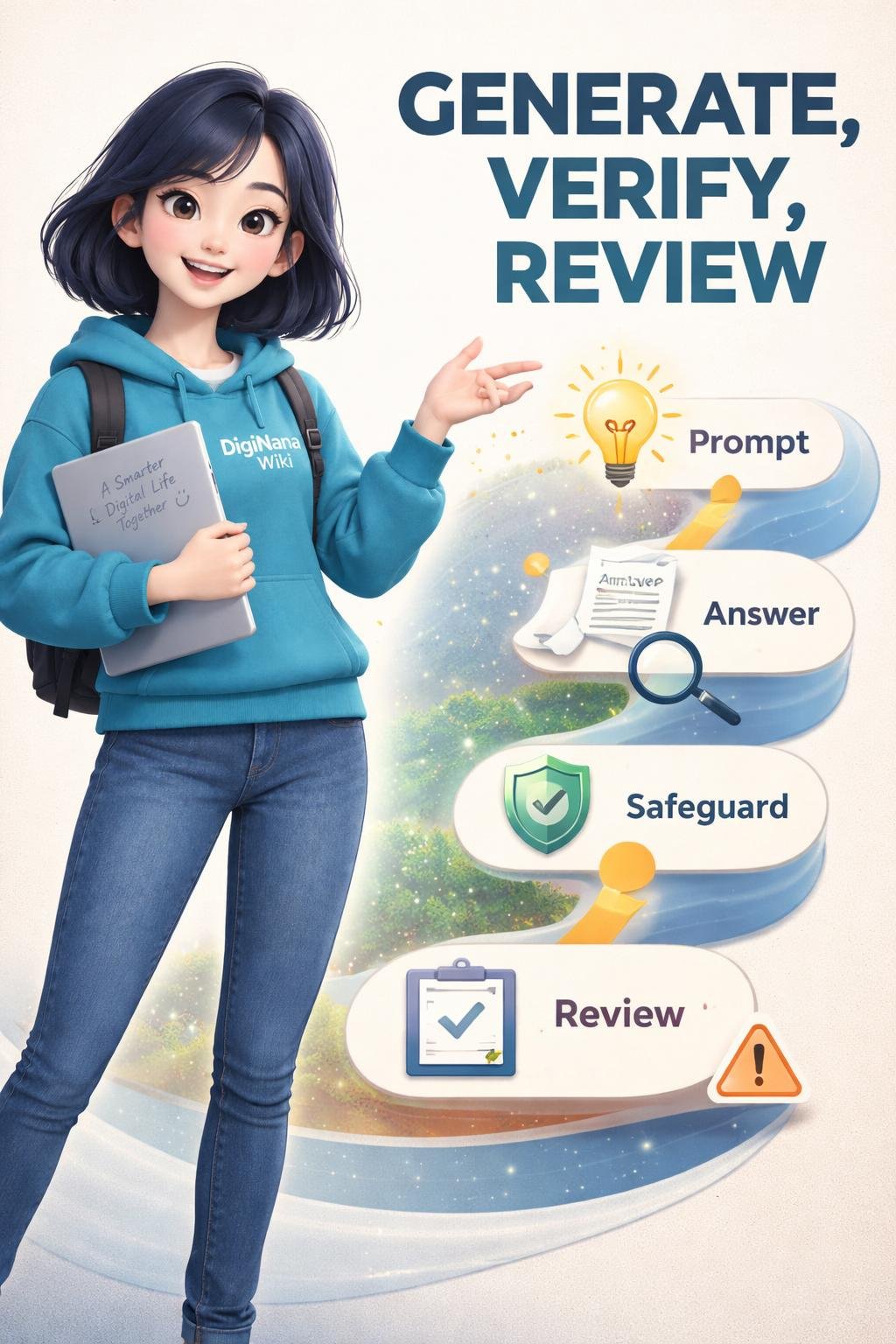
Generative AI produces statistically plausible output rather than guaranteed truth. Hallucinations can arise from data quality and coverage, model design limits, unclear or unfamiliar prompts, spurious correlations, and adversarial inputs.
Clear prompting, independent verification, human review, retrieval-based methods, monitoring, and other technical safeguards can reduce the risk. They do not remove it completely, so fluent AI-generated content should never be assumed to be accurate without appropriate checks.
References
- What Are AI Hallucinations? | IBM — https://www.ibm.com/think/topics/ai-hallucinations?_nospa=true
- Google Search’s Guidance on Generative AI Content on Your Website | Google Search Central | Documentation | Google for Developers — https://developers.google.com/search/docs/fundamentals/using-gen-ai-content?iframe=yes
Image Credits
The five DigiNana Wiki visuals accompanying this article are original educational illustrations created with AI assistance. They are conceptual images and must not be interpreted as verified photographs, exact software interfaces, actual device specifications, or guaranteed technical configurations.
Disclaimer
This article provides general educational information. Technical information, software interfaces, product features, security conditions, and service availability can change. Consult current official documentation whenever accuracy, security, privacy, or available functionality is important.