Introduction
To answer the question what is reinforcement learning, it helps to think about learning through interaction. An artificial intelligence agent makes a decision, observes the result, receives feedback, and adjusts its decision strategy during training.
Reinforcement learning is especially relevant to sequential decision-making, where one action changes the situation faced by the agent and may affect later rewards. This article explains the process, its main components, its limitations, and the questions beginners should ask when evaluating reinforcement learning systems.
What Is Reinforcement Learning?
Reinforcement learning is a type of machine learning in which an agent interacts with an environment, receives feedback, and learns to optimize its behavior according to a reward function.
The agent is the decision-maker. The environment is the setting in which it acts. Feedback can include positive rewards, negative rewards or penalties, and zero rewards. During training, this feedback guides the agent toward a policy intended to maximize cumulative reward.
Unlike a process that simply supplies the correct action for every situation, reinforcement learning uses trial-and-error interaction. The agent must learn which actions tend to support its specified goal over a sequence of decisions.
Why Reinforcement Learning Matters

Reinforcement learning provides a framework for problems in which decisions affect what happens next. After an agent takes an action, the environment can move into a different state, giving the agent a new situation and another decision to make.
This focus on sequences is important because the effect of an action may extend beyond its immediate reward. An action with a small short-term reward could contribute to a larger future reward, while an attractive immediate reward might not support the best cumulative result.
The method therefore connects individual actions with longer-term consequences. Its usefulness depends on how the environment, available actions, feedback, and objective are defined; it does not by itself establish that a particular product will perform well.
How Reinforcement Learning Works

A basic reinforcement learning interaction follows a repeating cycle:
- The agent observes the current state of the environment.
- It selects an available action according to its policy.
- The action affects the environment and may change its state.
- The environment returns a positive, negative, or zero reward.
- During training, the agent uses that feedback to update its policy.
A policy is the strategy that maps states to actions. Policy updates are intended to make actions associated with better cumulative outcomes more likely when similar states appear again.
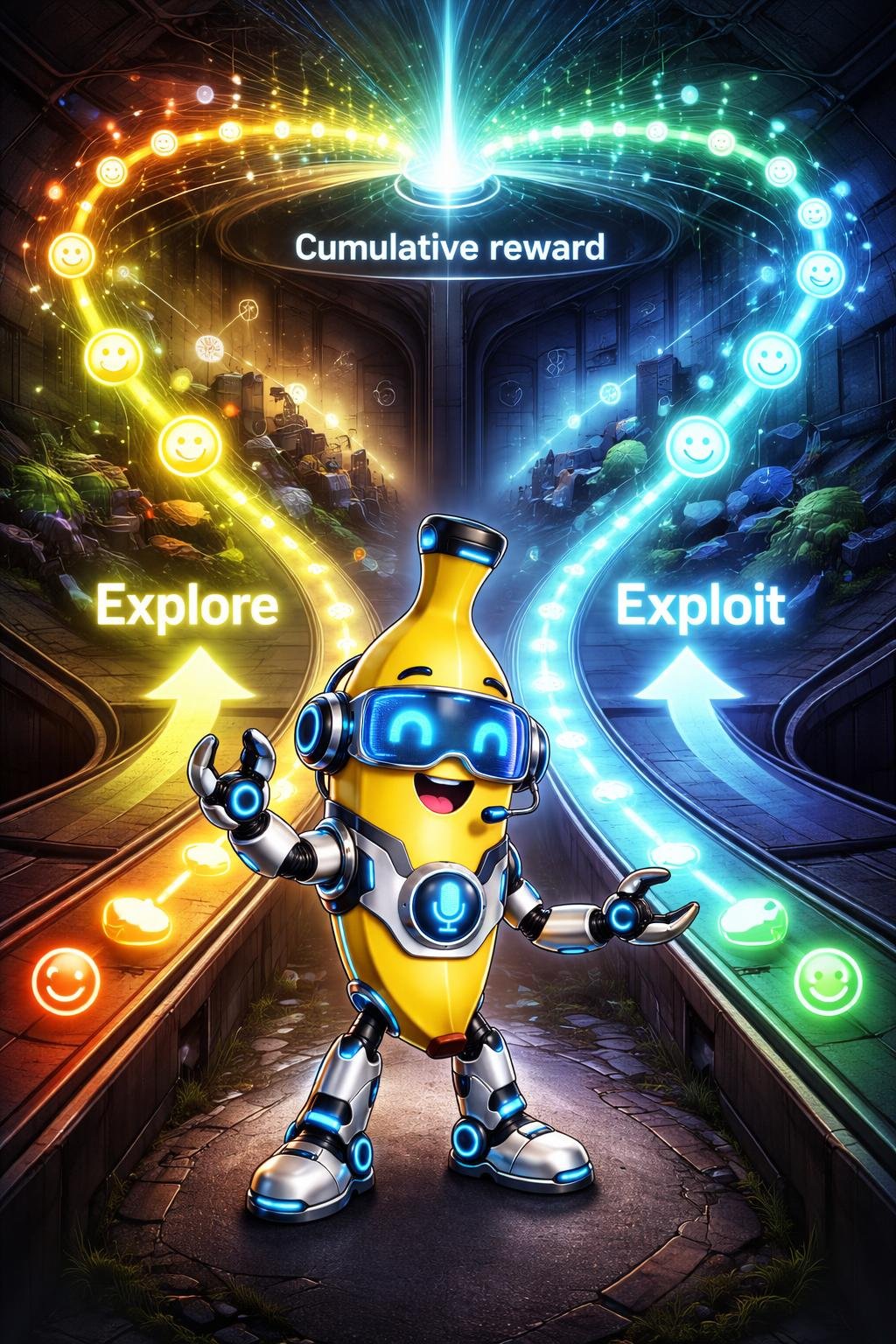
Cumulative reward concerns the rewards produced across a sequence rather than only the feedback from one action. This allows future consequences to be considered as part of the learning objective.
The agent must also balance exploration and exploitation. Exploration means trying unfamiliar actions to gather information about their consequences. Exploitation means choosing actions already associated with higher rewards. Relying only on familiar actions may prevent the agent from discovering alternatives, while excessive exploration may repeatedly select actions with uncertain results.
Training and later action selection are related but different activities. During training, interaction and reward feedback are used to update the policy. When a learned policy is used to select an action, the policy maps the observed state to a decision; that individual selection does not necessarily mean the policy is being updated at that moment.
Key Components of Reinforcement Learning
| Component | Beginner-friendly explanation | Relationship to the process |
|---|---|---|
| Agent | The decision-maker that selects actions. | It interacts with the environment and follows a policy. |
| Environment | The setting in which the agent acts. | It supplies states and returns reward feedback after actions. |
| State | Information describing the agent’s current situation. | The policy uses the state when selecting an action. |
| Action | A choice available to the agent. | It can change the environment and lead to feedback. |
| Reward signal | Immediate numerical feedback about success or progress. | It may be positive, negative, or zero. |
| Reward function | The part of the setup that determines the feedback used to guide behavior. | It expresses the specified objective through rewards. |
| Cumulative reward | Reward considered across a sequence of decisions. | It makes future consequences relevant to the objective. |
| Policy | A strategy mapping states to actions. | Training updates it to improve expected cumulative reward. |
| Value function | An estimate of long-term benefit. | It helps represent the potential future value associated with a situation or decision. |
| Environment model | An optional representation used to predict outcomes. | When present, it can represent how actions may affect the environment. |
In deep reinforcement learning, a policy can be represented by a neural network. This describes how the policy may be represented; it does not mean that every reinforcement learning system must use the same representation.
Everyday Examples
Hypothetical example: Choosing a route
Imagine a fictional learning agent choosing between several routes on a simple map. The current location is the state, and the available routes are the actions. Reaching the destination provides a positive reward, while entering an unhelpful route provides a penalty.
A route that looks useful immediately might lead to a poor later position. The illustration therefore shows why cumulative reward can matter more than judging each turn in isolation. This is an educational analogy, not a claim about a real navigation product.
Hypothetical example: Sorting digital cards
Consider a fictional agent arranging numbered cards into a requested order. The current arrangement is the state, and moving a card is an action. A move that improves the arrangement might receive a positive reward, an unhelpful move might receive a negative reward, and a neutral move might receive zero reward.
Trying a new move represents exploration, while repeating a previously useful move represents exploitation. This scenario illustrates reinforcement learning terms only; it is not evidence of a documented system or test.
Benefits and Limitations
Potential benefits
- It provides a structure for learning through interaction and feedback.
- It addresses sequences in which one action changes the state for later decisions.
- Its cumulative-reward objective can account for future as well as immediate feedback.
- It includes a way to reason about trying unfamiliar actions versus using known actions.
Important limitations and trade-offs
- The learned behavior is guided by the specified reward or goal. Reinforcement learning does not independently establish that this objective is appropriate.
- Exploration and exploitation create a trade-off: the agent needs information about alternatives while also using what it has already learned.
- A policy optimized through feedback is not a guarantee of a correct action in every situation.
- The framework alone does not prove real-world performance, safety, privacy, or suitability for a particular use.
Claims about a specific implementation require evidence about that implementation. General explanations of reinforcement learning should not be treated as verified benchmarks or guarantees.
Common Misunderstandings
“A reward must be a physical prize.”
In reinforcement learning, a reward is a feedback signal used to guide learning. It is not necessarily a physical object or a human-style prize.
“A penalty must be separate from a reward.”
A counterproductive action can receive a penalty expressed as a negative reward. Reward feedback may also be positive or zero.
“The agent is told the correct action every time.”
Reinforcement learning is based on trial-and-error interaction. The agent selects actions and receives feedback that is used to update its policy during training.
“Only the immediate reward matters.”
The objective is cumulative reward, so feedback and consequences across a sequence can matter. A decision cannot always be understood by looking only at its immediate reward.
“A learned policy is always correct.”
A learned policy is a strategy for choosing actions according to the training objective. Its existence does not guarantee correctness, safety, or suitability in every situation.
DigiNana Beginner Guide
Fictional educational scenario: DigiNana creates a story about a virtual character learning to reach a library on a small grid. This is an illustration, not a real test, product, software interface, or documented deployment.
The virtual character is the agent, and the grid is the environment. Its position on the grid represents the current state. At each step, the available actions are moves to permitted neighboring squares.
In the story, reaching the library produces a positive reward. Moving into an unhelpful square produces a negative reward or penalty, while another move may produce zero reward. The character initially tries different moves, illustrating exploration.
During fictional training rounds, reward feedback is used to update the character’s policy, which maps grid positions to moves. As the policy changes, actions associated with better outcomes may become more likely in similar states.
DigiNana then asks the learner to compare two routes. One route offers an early positive reward but does not reach the library. Another requires more steps but eventually reaches the goal and produces a better total result. This demonstrates why cumulative reward considers the sequence rather than only one immediate signal.
The story separates the technical concepts from the fiction: agent, environment, state, action, reward, policy, and cumulative reward are reinforcement learning concepts, while the grid and library are invented teaching devices.
Practical Tips
When reading an explanation or claim about reinforcement learning, use these checks:
- Identify the agent. Determine which model or decision-making system selects actions.
- Identify the environment. Look for the setting that supplies states and responds to actions.
- Define states and actions. Ask what information describes a situation and which choices are available.
- Inspect the reward. Determine what feedback is positive, negative, or zero and what objective it represents.
- Consider future consequences. Check whether the explanation addresses cumulative reward rather than only immediate feedback.
- Look for exploration and exploitation. Ask how unfamiliar actions and previously rewarded actions are treated.
- Separate training from policy use. Updating a policy through feedback is different from selecting an action with a learned policy.
- Check the evidence. Keep hypothetical teaching examples and marketing statements separate from verified descriptions of actual system behavior.
Safety, Privacy, Bias, and Responsible Use

Responsible evaluation begins with the goal and feedback used to guide the agent. Readers should ask what behavior the reward function encourages, what information forms the state, which actions are available, and how claimed results were verified.
A general statement that a system uses reinforcement learning does not by itself verify its accuracy, safety, privacy protections, security conditions, or treatment of bias. Those matters require evidence about the particular system and its operating context. Outputs should not be treated as automatically correct merely because a policy was trained with rewards.
Privacy questions can include what information is used to describe the environment and whether a documented system explains how that information is handled. Bias-related review can include examining whose preferences or goals shape feedback. These are evaluation questions, not claims that every reinforcement learning system has the same data, safeguards, or risks.
Reinforcement learning from human feedback (RLHF) extends the reinforcement learning process by training a reward model from human preferences. This can allow subjective feedback to guide policy optimization when success is difficult to define mathematically. The use of human preferences does not, on its own, establish that every output is correct or appropriate.
Frequently Asked Questions
Can a reward be negative or zero?
Yes. Feedback after an action can be positive, negative, or zero. A penalty can be represented as a negative reward.
What does maximizing cumulative reward mean?
It means optimizing for reward across a sequence of decisions, including future consequences, rather than focusing only on the reward received after one action.
What is a policy?
A policy is the agent’s strategy for mapping observed states to actions. During training, feedback is used to update that strategy.
What is the difference between exploration and exploitation?
Exploration involves trying unfamiliar actions to learn about their outcomes. Exploitation involves choosing actions already associated with higher rewards.
What makes reinforcement learning “deep”?
In deep reinforcement learning, the policy can be represented by a neural network. The term describes this representation and does not guarantee a particular level of performance.
What is reinforcement learning from human feedback?
Reinforcement learning from human feedback uses human preferences to train a reward model. That reward model can then guide policy optimization where the desired result is difficult to define mathematically.
Final Takeaway

Reinforcement learning is a machine learning approach in which an agent interacts with an environment and uses reward feedback to improve a policy for sequential decisions. The objective is to maximize cumulative reward, so future consequences can matter alongside immediate feedback.
Understanding the method requires identifying the agent, environment, states, actions, reward signal, and policy. It also requires recognizing the exploration-versus-exploitation trade-off and the limits of the specified goal. A learned policy is not an automatic guarantee of accuracy, safety, or correct behavior in every situation.
References
- What is reinforcement learning? | IBM
URL: https://www.ibm.com/think/topics/reinforcement-learning?from=20421&from_column=20421
- What Is Reinforcement Learning From Human Feedback (RLHF)? | IBM
URL: https://www.ibm.com/think/topics/rlhf?content_language=English
- What is Reinforcement Learning? – Reinforcement Learning Explained – AWS
URL: https://aws.amazon.com/what-is/reinforcement-learning/?sc_channel=el&trk=c4ea046f-18ad-4d23-a1ac-cdd1267f942c
- reinforcement learning – Glossary | CSRC
URL: https://csrc.nist.gov/glossary/term/reinforcement_learning
Image Credits
The five DigiNana Wiki visuals accompanying this article are original educational illustrations created with AI assistance. They are conceptual learning aids and must not be interpreted as verified photographs, exact software interfaces, actual device specifications, or guaranteed technical configurations.
Disclaimer
This article provides educational information about reinforcement learning. Technical information, software interfaces, product features, security conditions, and service availability can change. When an important decision depends on current operational details, consult up-to-date official documentation for the relevant technology or service.