
Introduction
To answer the question “what is deep learning,” start with its place in artificial intelligence: deep learning is a subset of machine learning that uses artificial neural networks with multiple processing layers. It helps models learn complex patterns from data, especially images, speech, text, and other forms of unstructured information.
Deep learning is important because many digital tasks involve data that does not fit neatly into rows and columns. Understanding its basic operation also makes it easier to evaluate claims about AI models, products, and services.
What Deep Learning Is
Deep learning is a machine learning approach based on multilayer artificial neural networks. An artificial neural network is a computational model made of connected processing units commonly called artificial neurons.
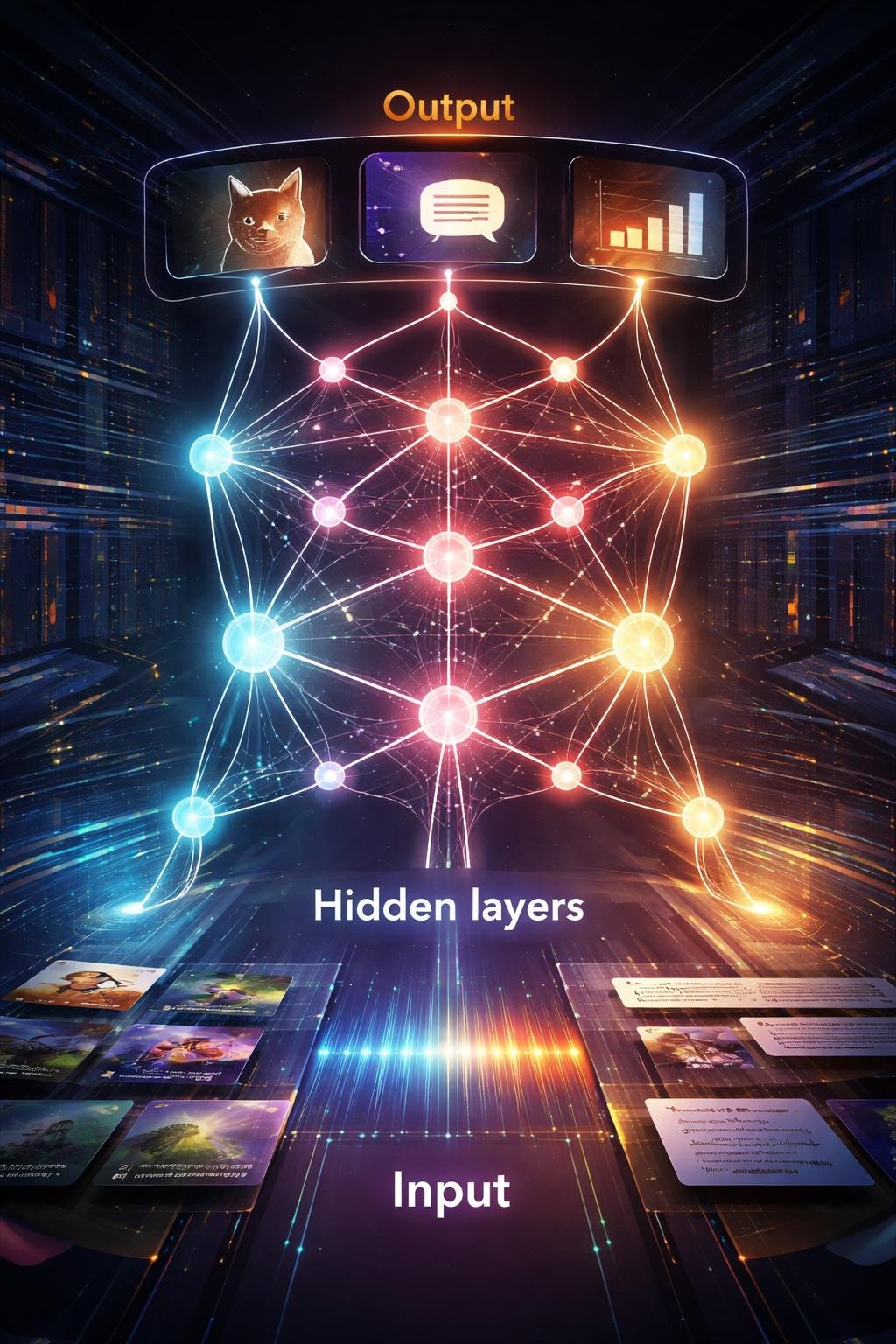
These networks contain an input layer, one or more hidden layers, and an output layer. The word “hidden” means that the layer sits between the input and output rather than being directly exposed as either one.
Deep learning is a form of representation learning. Instead of requiring people to define every useful feature manually, a deep network can learn internal representations from data. Earlier layers may respond to broad or simple patterns, while later layers combine those results into more detailed or abstract patterns.
The layers apply nonlinear mathematical operations. Nonlinearity helps the network model relationships that cannot be represented adequately by a simple straight-line relationship. Combining multiple nonlinear layers enables a deep network to learn complex, hierarchical patterns.
How Deep Learning Differs from Machine Learning
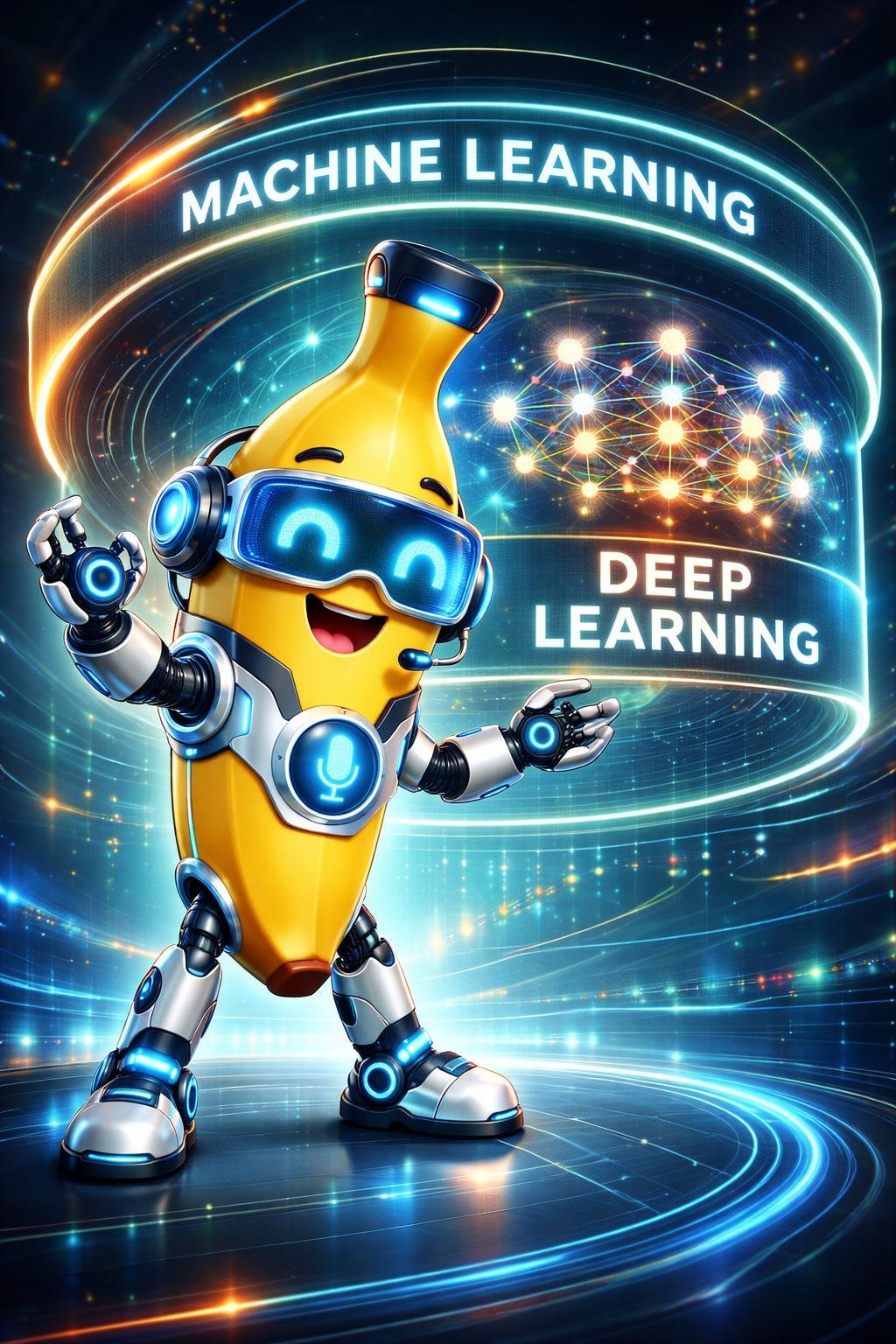
Machine learning is the broader field. It uses algorithms to identify patterns in data and create models that can produce predictions or other outputs. Deep learning is one approach within that field rather than a separate alternative to machine learning.
Broader machine learning includes methods such as regression, decision trees, clustering, reinforcement learning, and neural networks. These labels are not always mutually exclusive because they can describe different aspects of a learning system. Deep learning specifically refers to the use of neural networks with multiple processing layers.
| Area | Deep learning | Other machine learning methods |
|---|---|---|
| Feature handling | Can learn useful representations and features directly from data. | May depend more heavily on features selected or designed by people. |
| Typical data strengths | Especially effective with large amounts of unstructured data. | Can be practical for structured or labeled data, depending on the method. |
| Relationships modeled | Can represent complex nonlinear relationships through many adjustable layers. | Complexity varies among regression, decision trees, clustering, and other methods. |
| Computing requirements | Generally requires more computing power and may use graphics processing units or tensor processing units. | Some methods can train faster on standard central processing units. |
| Training time | Training can take longer because many parameters must be adjusted. | Some approaches can train more quickly. |
| Interpretability | Often more difficult to interpret and may behave like a black box. | Some methods offer more understandable relationships between inputs and outputs. |
The best approach depends on the task, available data, computing resources, and need for interpretability. Deep learning is not automatically the most suitable method for every machine learning problem.
Why Deep Learning Matters
Deep learning matters because it can learn complex patterns from large amounts of unstructured data. Unstructured data includes information such as images, audio, speech, and natural-language text that does not arrive in a simple table of predefined fields.
Its ability to learn representations automatically is useful for image recognition, speech recognition, object detection, and natural-language processing. These tasks can require a model to identify many interacting patterns rather than rely on one manually defined rule.
Deep learning therefore provides an important technical foundation for systems that process visual, audio, and language information. Its usefulness does not remove the need to assess the data, training process, output quality, cost, and limitations of the resulting model.
How Deep Learning Works

Data moves through the network
Input data enters the network through an input layer. Each hidden layer processes the information and passes its output to the next layer. The output layer produces the model’s result, such as a classification or another predicted value.
Training measures and reduces error
During training, the network produces outputs from training data. A loss function measures the difference between the produced output and the desired result used by the training process.
Backpropagation calculates how the network’s internal parameters contributed to the error. Gradient descent then updates parameters such as weights and biases in a direction intended to reduce the loss. Repeating this process allows the network to learn representations that are useful for its task.
Validation checks the developing model
Machine learning models can be validated against known data as part of evaluating and adjusting the training process. Validation is different from simply continuing to fit the model to the same training examples. The exact validation procedure depends on the project and should be checked in its technical documentation.
Inference uses the trained model
Training is the process of adjusting the model’s parameters. After training, using the resulting model to process a new input and produce an output is commonly called inference. Inference uses what the model learned; it does not mean that the model’s answer is automatically correct.
Key Components of a Deep Learning System
- Data: The examples or inputs from which the network learns. The suitability and amount of data affect what training can accomplish.
- Artificial neurons: Connected processing units that perform mathematical operations on incoming information.
- Layers: The input layer receives data, hidden layers learn intermediate representations, and the output layer produces a result.
- Weights and biases: Adjustable parameters that control how inputs are mapped to outputs.
- Nonlinear operations: Mathematical operations that allow the model to represent relationships more complex than simple linear mappings.
- Loss function: A calculation used during training to measure model error.
- Backpropagation: The process used to determine how internal parameters affected the measured error.
- Gradient descent: A method for updating parameters to reduce the loss.
- Computing resources: Deep learning generally requires substantial computing power, particularly for large or customized models.
Different network forms are suited to different kinds of data. Convolutional networks are effective for images, video, speech, and audio. Recurrent networks are used for sequential data such as text and speech. These network types remain deep learning models when they contain multiple processing layers.
Everyday Examples of Deep Learning
Verified technical use: Image recognition. Deep learning can learn visual representations that support the classification of image content.
Hypothetical illustration: A model might receive a new image and return one of several categories it learned during training. This example explains the process and does not claim that a particular application uses deep learning.
Verified technical use: Object detection. Deep learning can support tasks that detect objects within visual data rather than only assigning one category to an entire image.
Hypothetical illustration: A visual system could be trained to identify specified object types in an image. Its output would still require evaluation rather than being treated as guaranteed fact.
Verified technical use: Speech recognition. Deep learning networks can process speech and audio patterns.
Hypothetical illustration: A trained model could receive a spoken sequence and produce a corresponding text output. This does not identify or verify the technology used by any particular voice service.
Verified technical use: Natural-language processing. Deep learning can process patterns in text and other sequential language data.
Hypothetical illustration: A model could classify a passage into categories learned during training. The illustration describes a possible task, not a real product test.
Benefits, Limitations, and Trade-Offs
Potential benefits
- Deep networks can automate part of the feature-extraction process.
- Multiple layers can learn representations at progressively higher levels of abstraction.
- Nonlinear processing enables models to represent complex relationships.
- The approach is effective for large amounts of unstructured data and tasks involving images, speech, objects, and language.
Important limitations
- Deep learning generally needs more training data than many traditional machine learning approaches.
- Training can require greater computing power, including specialized resources in some projects.
- Training may take longer because the network has many adjustable parameters.
- Highly customized or exploratory models can require substantial investment.
- The learned decision process may be difficult to interpret, leading to black-box behavior.
These characteristics create practical trade-offs. Automated representation learning can reduce manual feature engineering, but the resulting model may demand more data, computation, training time, and effort to understand.
Common Misunderstandings About Deep Learning
“Deep learning and machine learning are separate fields.”
Deep learning is a subset of machine learning. It is one way of building machine learning models, not a field that sits outside machine learning.
“Every AI system is a deep learning model.”
Artificial intelligence is broader than machine learning, and machine learning is broader than deep learning. A system described as AI is therefore not necessarily based on a deep neural network.
“Adding more layers automatically makes a model better.”
Multiple layers can enable more complex representations, but the supplied evidence does not establish that simply increasing depth guarantees a better result. Suitable data, training, validation, evaluation, computing resources, and task design still matter.
“Deep learning removes the need to prepare or evaluate data.”
Automated feature learning does not remove the need for appropriate training data or model evaluation. A model learns from the information available during training, and its outputs must still be checked for the intended use.
“An AI model and an AI product are the same thing.”
A model is the trained computational component that maps inputs to outputs. A product or service may contain a model alongside an interface, data-processing steps, storage, security controls, and other software. A claim about a model should not automatically be treated as a claim about an entire product.
DigiNana Beginner Guide
Fictional educational example: DigiNana wants to explain how an image-classification model might learn. This story is an illustration only; it is not a real test, product, dataset, or performance claim.
- DigiNana begins with a collection of suitable training images and the categories required by the hypothetical task.
- Each image enters the model through its input layer.
- The hidden layers process the image through learned weights, biases, and nonlinear operations. Across the layers, the model develops internal representations useful for distinguishing the categories.
- The output layer produces a category result during training.
- A loss function measures the model’s error. Backpropagation identifies how parameters contributed to that error, and gradient descent updates them.
- After repeated training and appropriate evaluation, the trained model can receive a new image and produce an output. This later use is inference.
DigiNana’s example shows the basic path from data to training and then to model output. It does not imply that the output is always accurate or that every image-classification system uses the same design.
Practical Tips
- Identify the task. Ask whether the system is classifying images, detecting objects, processing speech, analyzing text, or performing another defined operation.
- Look at the data type. Deep learning is especially relevant to large collections of unstructured information, but that alone does not prove it is the best method.
- Separate training from inference. Training adjusts model parameters, while inference uses the trained model to produce an output from a new input.
- Distinguish a model from a product. Product reliability, privacy, security, and availability involve more than the model alone.
- Ask about trade-offs. Consider data requirements, computing needs, training time, investment, and interpretability.
- Check how results are evaluated. Do not treat a model output or a broad marketing description as proof of accuracy for a particular situation.
- Consult current official documentation. Implementation procedures, interfaces, supported features, and computing requirements can vary and change.
These checks help beginners assess deep learning claims without assuming that technical complexity guarantees usefulness or reliability.
Safety, Privacy, Bias, and Responsible Use

Deep learning outputs should not be assumed to be correct. A model produces results from patterns learned during training, so important outputs require evaluation appropriate to their intended use.
Privacy should be considered before data is submitted to a training process, model, product, or online service. Users and project teams should identify what data is being handled, whether it contains sensitive information, and what current official documentation says about its collection, storage, and use.
Bias and uneven results also require attention. Responsible evaluation should examine whether the data and outputs are suitable across the people, situations, or categories affected by the application. The supplied sources do not establish a universal mechanism that can guarantee unbiased output.
Language and other generated outputs can be inaccurate or misleading. They should not be presented as verified facts merely because they were produced by a deep learning model. Human review, appropriate testing, and clear communication of uncertainty are important when errors could matter.
Security conditions depend on the complete system rather than the model alone. Current official guidance should be used for specific data-handling, access-control, deployment, and security decisions.
Frequently Asked Questions
Is deep learning a type of machine learning?
Yes. Deep learning is a subset of machine learning based on artificial neural networks with multiple processing layers.
Why does deep learning need substantial data and computation?
Deep networks contain many adjustable parameters and learn representations across multiple layers. Training these models generally requires more data, computing power, and time than many broader machine learning methods.
Does deep learning always require labeled data?
Labeled data is commonly used in deep learning training, but “commonly” should not be interpreted as “always.” The data and training setup depend on the method and task, so specific requirements should be verified in the relevant technical documentation.
What do hidden layers do?
Hidden layers transform information between the input and output layers. Successive layers can learn progressively more abstract or detailed representations of patterns in the data.
Why can deep learning models be difficult to interpret?
The final output can depend on many parameters and nonlinear transformations distributed across multiple layers. This complexity can make it difficult to explain exactly how each part of an input contributed to a particular output.
When might another machine learning method be more practical?
A broader machine learning method may be more practical when the available data is limited or structured, computing resources are constrained, faster training is important, or greater interpretability is required. The appropriate choice depends on the task rather than on deep learning being universally superior.
Final Takeaway

Deep learning is a subset of machine learning that uses multilayer artificial neural networks. Its main strength is representation learning: multiple nonlinear layers can learn hierarchical features directly from data and model complex relationships.
This approach is particularly useful for large amounts of unstructured data and tasks involving images, objects, speech, audio, and natural language. Its benefits come with trade-offs, including greater data and computing needs, longer training, investment demands, and lower interpretability.
Understanding those trade-offs helps beginners distinguish deep learning from the wider range of machine learning methods and evaluate whether it is appropriate for a particular task.
References
- Deep learning vs machine learning vs AI | Google Cloud — URL: https://cloud.google.com/discover/deep-learning-vs-machine-learning
- AI Technology Overview – Azure Architecture Center | Microsoft Learn — URL: https://learn.microsoft.com/en-us/azure/architecture/ai-ml/ai-overview
- Tutorial: Deep Learning – Microsoft Research — URL: https://www.microsoft.com/en-us/research/video/tutorial-deep-learning/
- What Is Deep Learning? | IBM — URL: https://www.ibm.com/think/topics/deep-learning
These are the verified sources used for this article.
Image Credits
The five DigiNana Wiki visuals accompanying this article are original educational illustrations created with AI assistance. They are conceptual images and must not be interpreted as verified photographs, exact software interfaces, actual device specifications, or guaranteed technical configurations.
Disclaimer
This article provides general educational information. Technical information, software interfaces, product features, security conditions, and service availability can change. Verify important or current implementation details through the relevant official documentation before making technical, privacy, security, or deployment decisions.